
Step-by-Step Guide to LiDAR Annotation for Beginners
Quick Answer
Learn how to annotate LiDAR data efficiently with this comprehensive guide designed for beginners in the Philippines.
Table of Contents
- 1.Understanding LiDAR Annotation Basics
- 2.Choosing the Right Tools for 3D LiDAR Annotation
- 3.Step-by-Step Process to Annotate LiDAR Data
- 4.Common Challenges in LiDAR Annotation and Solutions
- 5.Philippines' Market Potential in LiDAR Annotation
- 6.Unique Insight: The Importance of High-Quality Annotations
- 7.Frequently Asked Questions
LiDAR annotation is transforming industries from autonomous vehicles to urban planning. But getting started can seem daunting. Here's how you can dive in, especially if you're in the Philippines where tech skills are increasingly in demand.
LiDAR annotation involves labeling 3D point cloud data captured by LiDAR sensors to help machines understand their environment. This process is crucial for developing applications in autonomous driving, robotics, and more.
Table of Contents
- Understanding LiDAR Annotation Basics
- Choosing the Right Tools for 3D LiDAR Annotation
- Step-by-Step Process to Annotate LiDAR Data
- Common Challenges in LiDAR Annotation and Solutions
- Philippines' Market Potential in LiDAR Annotation
- Unique Insight: The Importance of High-Quality Annotations
- Frequently Asked Questions
Understanding LiDAR Annotation Basics
LiDAR, which stands for Light Detection and Ranging, uses laser beams to measure distances. It creates a 3D representation of the environment, known as a point cloud. Annotation involves tagging these points with labels to identify objects, such as cars or pedestrians, in the data. This is essential for training machine learning models to interpret real-world scenes. By understanding LiDAR annotation, individuals can contribute to significant advancements in technology, particularly in sectors that rely heavily on precise spatial data.
The process of LiDAR annotation requires a keen understanding of spatial awareness and the ability to recognize different objects within a 3D space. Each point in a point cloud represents a specific location in space, and when annotated, these points help build a comprehensive understanding of the physical environment. This data is crucial for developing systems that need to navigate or interact with the world autonomously, such as self-driving cars or delivery drones.
Moreover, LiDAR annotation is not just about marking objects but involves understanding the context in which these objects exist. For example, annotating a pedestrian crossing a street involves not only labeling the pedestrian but also the street, vehicles, and surrounding environment. This contextual annotation enhances the machine's ability to make informed decisions based on the environment it perceives.
Choosing the Right Tools for 3D LiDAR Annotation
To start annotating LiDAR data, you'll need the right software. Tools like Labelbox, Supervisely, and Scale AI offer platforms for efficient LiDAR annotation. When selecting a tool, consider features like ease of use, support for 3D point clouds, and integration capabilities. For beginners, platforms with intuitive interfaces can reduce the learning curve significantly. It's essential to choose tools that provide robust support and have a community or customer service that can assist in troubleshooting and learning.
Each tool has unique features that cater to different needs. For instance, Labelbox provides a user-friendly interface with active learning capabilities, which can significantly speed up the annotation process by predicting labels that need verification. Supervisely, on the other hand, offers powerful visualization tools that can handle large datasets, making it suitable for projects with extensive data requirements. Scale AI is known for its scalable solutions that are ideal for enterprises needing to annotate large volumes of data quickly.
Investing time in learning how to use these tools effectively can lead to significant gains in productivity and quality. Many of these platforms offer tutorials and documentation that can help newcomers understand their functionalities better. Additionally, joining online forums or communities focused on LiDAR annotation can provide valuable insights and tips from experienced users. As the field continues to grow, staying updated with the latest tools and techniques is critical for anyone looking to specialize in LiDAR annotation.
Step-by-Step Process to Annotate LiDAR Data
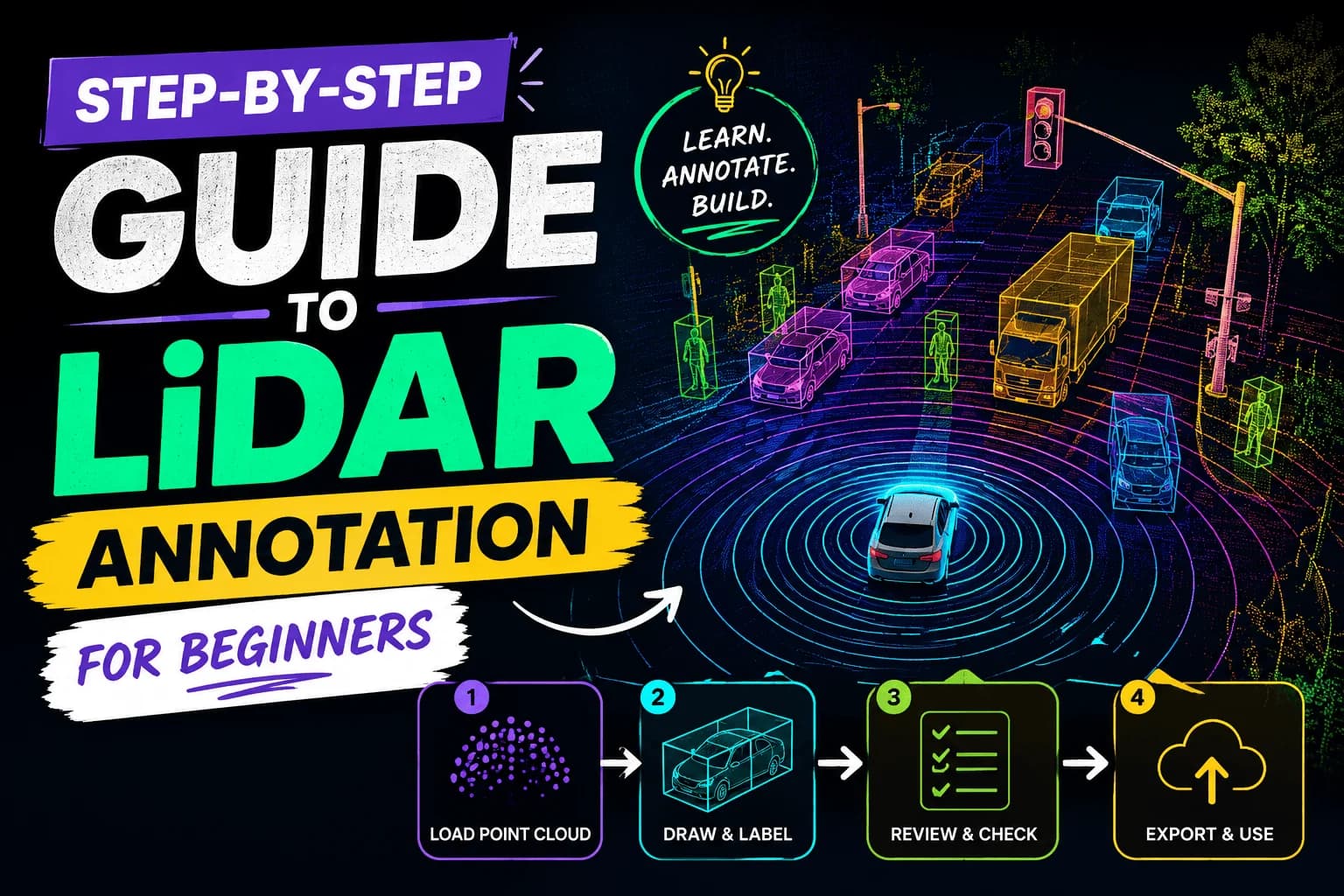
- Import Data: Start by uploading your LiDAR data into the annotation tool. Ensure the data is in a compatible format, usually .las or .laz files. Before uploading, it's crucial to organize your data efficiently, especially if you're working with large datasets. Proper data management can save time and reduce errors during the annotation process.
- Select Annotation Type: Depending on your project, choose between bounding boxes, semantic segmentation, or instance segmentation. Each serves different purposes in data labeling. Bounding boxes are typically used for object detection, while semantic segmentation is used for understanding the context of the scene by labeling each point with a class. Instance segmentation goes a step further by distinguishing between different instances of the same object class.
- Begin Labeling: Use the tool's interface to draw and label objects in the point cloud. Precision is key to ensuring data accuracy. Take your time to adjust labels precisely. Often, tools will provide shortcuts or advanced features like snapping to make this process more efficient. It's recommended to start with simpler scenes and gradually move to more complex ones as you gain confidence.
- Review and Adjust: Once labeling is complete, review your work for accuracy. Make necessary adjustments to incorrect labels. Peer reviews or automated quality checks provided by some tools can help ensure that your annotations meet the required standards. Regularly reviewing your annotations can prevent the propagation of errors, especially in large datasets.
- Export Annotated Data: After finalizing annotations, export the data in the required format for use in machine learning models. Ensure that the exported data maintains the integrity of your annotations to avoid issues during model training. Maintaining a log or report of your annotation process can be helpful for tracking progress and troubleshooting any issues that arise later.
Common Challenges in LiDAR Annotation and Solutions
Annotating LiDAR data can be challenging due to the complexity of 3D data and the need for precision. One common issue is dealing with occlusions, where objects are partially hidden. To overcome this, use advanced tools that offer features like point interpolation. Additionally, ensuring consistency in annotation is crucial. Regular training and quality checks can mitigate errors. It's also essential to have a structured workflow to efficiently manage the annotation process and reduce the chances of errors.
Another challenge is the sheer volume of data that needs to be annotated. Large datasets can be overwhelming, and the manual annotation can be time-consuming. To address this, teams can employ strategies such as dividing the workload among multiple annotators or using AI-assisted tools that can automate parts of the process. These tools can predict annotations based on previous data, which annotators can then verify. This not only speeds up the process but also ensures higher accuracy.
Annotation fatigue is another issue that can affect the quality of work. Long hours of annotating can lead to decreased attention to detail, resulting in errors. To combat this, it's important to take regular breaks and rotate tasks among team members. Implementing a system of checks and balances, such as having a second set of eyes review annotations, can also help maintain quality. Continuous learning and adaptation are key, as the field of LiDAR annotation is constantly evolving with new challenges and solutions.
Source: World Bank Open Data
Philippines' Market Potential in LiDAR Annotation
The Philippines, with a labor force of over 52 million World Bank, has a growing potential for tech-related jobs like LiDAR annotation. As the unemployment rate is relatively low at 2.24% World Bank, upskilling in fields like LiDAR can open new opportunities. The country's increasing internet penetration, at 67.26% of the population World Bank, supports the growth of online learning and remote work, making it easier to gain skills in this area.
With the rapid development of technology and infrastructure, the demand for skilled professionals in LiDAR annotation is expected to rise. Companies looking to outsource LiDAR annotation tasks can find a skilled workforce in the Philippines, where English proficiency and strong work ethics are advantageous. The cost-effectiveness of hiring in the Philippines also makes it an attractive destination for companies aiming to maximize their return on investment.
Moreover, as more educational institutions in the Philippines incorporate technology-related courses and programs, the talent pool for LiDAR annotation will continue to grow. This not only creates job opportunities but also positions the country as a competitive player in the global tech industry. By investing in skill development and technology adoption, the Philippines can leverage its human resources to capitalize on the increasing demand for LiDAR annotation services.
Unique Insight: The Importance of High-Quality Annotations
Quality is everything in LiDAR annotation. Poor annotations can lead to faulty AI models, which in critical applications like autonomous driving, can be disastrous. Investing time in precise annotations not only improves model accuracy but also boosts the safety and reliability of AI systems. Most people overlook this, focusing on quantity over quality. High-quality annotations ensure that the data fed into machine learning models is accurate and reliable, which is crucial for applications that require precision and safety.
In industries such as autonomous driving, the margin for error is minimal. A single misannotation can lead to incorrect model predictions, potentially resulting in accidents or system failures. Therefore, ensuring high-quality annotations is not just a matter of efficiency but a critical safety consideration. Companies investing in AI technologies must prioritize quality control in their annotation processes to avoid costly mistakes.
Furthermore, high-quality annotations contribute to the robustness of AI models. As models encounter diverse and complex real-world scenarios, the quality and accuracy of training data play a pivotal role in ensuring that the models can generalize well. By maintaining strict quality standards in LiDAR annotation, companies can develop more reliable and effective AI solutions, ultimately leading to better performance and outcomes in their respective fields.
Frequently Asked Questions
What is LiDAR annotation used for?
LiDAR annotation is primarily used to train AI models in recognizing and interpreting 3D environments. It's essential for autonomous vehicles, drones, and urban planning applications. By accurately labeling objects and environments, LiDAR annotation enables machines to navigate and interact with the world effectively.
How long does it take to annotate LiDAR data?
The time required depends on the complexity of the data and the chosen annotation tool. Simple scenes can take a few hours, while complex ones may require days. The efficiency of the annotation process can also be influenced by the annotator's experience and the level of automation provided by the tools being used.
Can I learn LiDAR annotation online?
Yes, there are numerous online resources and courses available that can help you learn LiDAR annotation skills. Given the internet penetration in the Philippines, it's easier than ever to access these educational materials. Online platforms offer tutorials, webinars, and forums where learners can interact with experts and peers to enhance their understanding of LiDAR annotation.
What skills are needed for LiDAR annotation?
Basic computer skills, attention to detail, and familiarity with annotation tools are essential. Having a background in data science or machine learning can be beneficial but is not mandatory. An understanding of spatial reasoning and the ability to recognize different object classes within a 3D space are also valuable skills for LiDAR annotators.
Are there job opportunities for LiDAR annotators in the Philippines?
Yes, as the demand for AI and machine learning continues to grow, there are increasing opportunities for LiDAR annotators both locally and internationally. The Philippines, with its skilled workforce and cost-effective labor market, offers a promising environment for companies seeking LiDAR annotation expertise.
You might also like
More guides on Ai Video Annotation.
How to Master Video Annotation: A Step-by-Step Guide
Learn the essential steps to excel in video annotation, a key skill in AI development. Perfect for beginners in the Philippines.
How to Annotate a Video: Step-by-Step Guide for Beginners
Learn how to annotate a video with this detailed guide, perfect for beginners in the Philippines. Turn your videos into interactive experiences easily!
How to Use Annotation on YouTube: A Step-by-Step Guide
Learn how to effectively use annotation on YouTube to enhance viewer engagement with this detailed step-by-step guide.
Latest Virtual Assistant Jobs
Fresh remote VA roles: apply directly
Controller for Financial Operations at Ritual - Remote
Drive Business Performance as Chief of Staff, CCO at Ping Identity - Remote
Enterprise Account Executive for Federal Civilian at Asana - Hybrid
Lead Product-Led Growth Strategies at Upsun - Remote