
Understanding Employer SSS in the Philippines: Key Insights
Quick Answer
Explore the nuances of employer SSS in the Philippines, including roles, responsibilities, and the differences between employer types.
Table of Contents
- 1.What Does Employer SSS Mean?
- 2.How Much Is the Employer SSS Contribution?
- 3.What Is Monthly Salary Credit?
- 4.Employer SSS vs. Employee SSS Contribution
- 5.Does the Employer Pay Anything Else to SSS?
- 6.Example: Employee With a ₱35,000 Monthly Salary Credit
- 7.What Are the Employer's SSS Responsibilities?
- 8.What Happens if an Employer Does Not Pay SSS Contributions?
- 9.Why SSS Contributions Matter to Employees
- 10.Can Employees Check Whether Their Employer Is Paying SSS?
- 11.Is SSS the Same as PhilHealth?
- 12.Is SSS the Same as Pag-IBIG?
- 13.SSS, PhilHealth, and Pag-IBIG at a Glance
- 14.What About Foreign Companies Hiring in the Philippines?
- 15.Who Pays SSS When Using an Employer of Record?
- 16.What Is the Difference Between Employer SSS and an Employer of Record?
- 17.Employer SSS Example for a Foreign Company
- 18.Frequently Asked Questions About Employer SSS
- 19.Employer SSS: The Simple Definition
Understanding Employer SSS in the Philippines: Key Insights
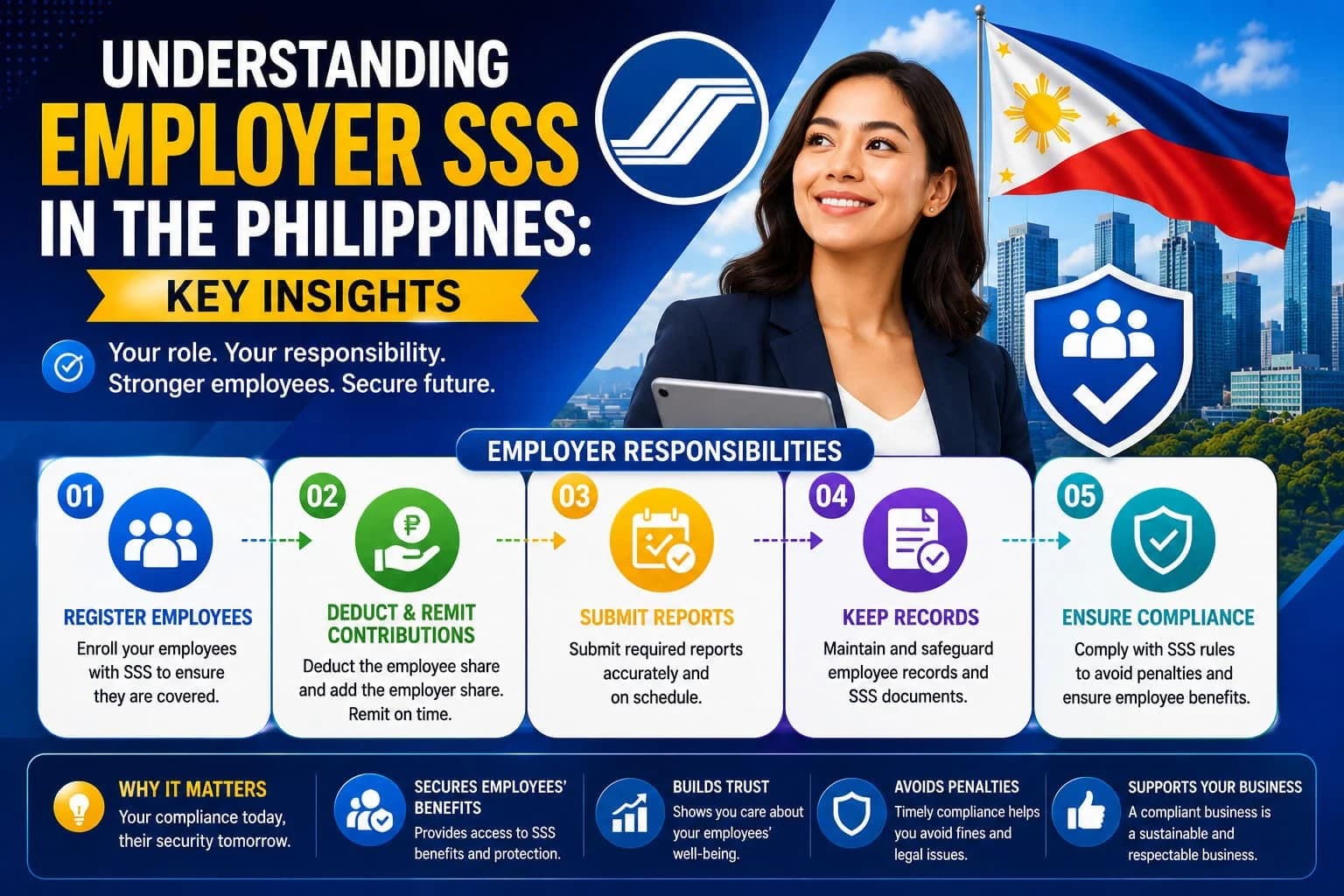
Employer SSS refers to the Social Security System responsibilities of an employer in the Philippines, including registering covered employees, reporting them to SSS, deducting the employee's share of contributions, paying the employer's share, and remitting the required amounts to the Social Security System.
For employees, SSS provides social protection against situations that can lead to loss of income or additional financial burden. Benefits include sickness, maternity, disability, retirement, death, funeral, and unemployment benefits, subject to eligibility requirements.
For employers, SSS is not an optional employee perk. It is part of the statutory responsibilities that come with employing covered workers in the Philippines.
The rules are particularly important for businesses hiring their first employees and foreign companies establishing a workforce in the Philippines.
What Does Employer SSS Mean?
When people refer to employer SSS, they are usually talking about the employer's responsibilities under the Philippine Social Security System.
For a covered employee, both the employer and employee contribute to SSS.
The employer generally has several responsibilities:
Register as an employer with SSS
Report covered employees
Calculate the applicable contribution
Deduct the employee's share from payroll
Pay the employer's share
Remit contributions to SSS
Maintain accurate employment and contribution records
The employer therefore does more than simply send its own contribution to SSS.
It also serves an important administrative role in making sure employees' contributions are properly reported and remitted.
Employers can find official information through the Social Security System.
How Much Is the Employer SSS Contribution?
As of 2026, the regular Social Security contribution rate is 15% of the employee's applicable Monthly Salary Credit, or MSC.
The contribution is divided between employer and employee:
Contribution | Rate |
|---|---|
Employer share | 10% |
Employee share | 5% |
Total | 15% |
The current contribution schedule took effect on January 1, 2025.
The maximum Monthly Salary Credit is ₱35,000.
This means that at the maximum MSC:
Employer share:
₱35,000 × 10% = ₱3,500
Employee share:
₱35,000 × 5% = ₱1,750
Total regular SS contribution:
₱35,000 × 15% = ₱5,250
The contribution calculation is based on the applicable Monthly Salary Credit rather than simply applying the percentage to an employee's entire salary without limit.
Employers should always use the current SSS contribution schedule. The official rates and contribution table are available on the SSS Pay Contributions page.
What Is Monthly Salary Credit?
The Monthly Salary Credit, commonly called MSC, is the compensation base SSS uses to determine contributions and benefits.
It is not necessarily the same as the employee's exact monthly salary.
SSS places compensation into corresponding Monthly Salary Credit levels under its contribution schedule.
As of January 2025, the regular contribution schedule has a minimum MSC of ₱5,000 and a maximum MSC of ₱35,000.
For employers, this means payroll systems need to identify the correct MSC before calculating the employer and employee contributions.
Employer SSS vs. Employee SSS Contribution
One of the most important things to understand is that the employer does not pay the entire regular SSS contribution.
The cost is shared.
For regular Social Security contributions:
Employer: 10% of the applicable MSC
Employee: 5% of the applicable MSC
The employee's portion is deducted from the employee's compensation.
The employer then adds its own share and remits the required contribution to SSS.
For example, suppose an employee's applicable MSC is ₱20,000.
The calculation would be:
Employer share:
₱20,000 × 10% = ₱2,000
Employee share:
₱20,000 × 5% = ₱1,000
Total regular SS contribution:
₱3,000
The employee therefore does not receive the ₱1,000 portion as part of net salary. It is deducted and remitted to SSS together with the employer's contribution.
Does the Employer Pay Anything Else to SSS?
Yes.
Employers should also be aware of the Employees' Compensation Program, or ECP.
Unlike the regular SSS contribution, the EC contribution is paid entirely by the employer.
The current EC contribution is:
Monthly Salary Credit | Employer EC Contribution |
|---|---|
₱14,500 and below | ₱10 |
₱15,000 and above | ₱30 |
The employee does not contribute to this portion.
For example, if an employee has an MSC of ₱35,000, the employer's SSS-related payment includes the applicable regular employer contribution plus the EC contribution.
Employers can learn more about this program through the SSS Employees' Compensation Program.
Example: Employee With a ₱35,000 Monthly Salary Credit
Suppose an employee has an applicable MSC of ₱35,000.
The regular Social Security contribution would be:
Component | Amount |
|---|---|
Employer SS share | ₱3,500 |
Employee SS share | ₱1,750 |
Total regular SS | ₱5,250 |
Employer EC contribution | ₱30 |
The employer therefore funds its own applicable share while withholding the employee's share through payroll.
This distinction matters when calculating the true cost of employing someone in the Philippines.
An employee's gross salary is not the company's complete employment cost.
Employers may also have costs associated with SSS, PhilHealth, Pag-IBIG, 13th-month pay, benefits, and other employment requirements.
What Are the Employer's SSS Responsibilities?
Paying contributions is only one part of employer SSS compliance.
Registering as an employer
A business employing covered workers must comply with applicable SSS employer registration requirements.
This establishes the employer's record with the Social Security System.
Reporting employees
Employers must properly report covered employees.
This is important because an employee's SSS record can affect access to benefits.
Deducting employee contributions
The employer calculates and deducts the employee's applicable contribution through payroll.
Paying the employer contribution
The employer adds its own required contribution.
The employer's portion should not simply be treated as an employee payroll deduction.
Remitting contributions
The required contributions must then be remitted to SSS through the appropriate payment channels and according to applicable deadlines.
Maintaining records
Employers should maintain accurate payroll and contribution records.
This becomes important if there is a discrepancy between company payroll records and an employee's SSS contribution history.
What Happens if an Employer Does Not Pay SSS Contributions?
Failure to properly report employees or remit SSS contributions can have serious consequences.
SSS states that an employer who fails to report employees violates the Social Security law.
According to SSS, an employer found liable may be required to:
Pay unpaid contributions
Pay applicable penalties
Become liable for benefits in certain circumstances
Face potential criminal penalties
SSS currently states that unpaid contributions can be subject to a penalty of 2% per month.
More information about employer responsibilities and the consequences of non-reporting and non-remittance is available from the SSS Employer page.
For businesses, this makes SSS compliance more than an administrative payroll task.
Missing contributions can create financial and legal problems for the company and problems for employees trying to access their benefits.
Why SSS Contributions Matter to Employees
SSS contributions help establish an employee's eligibility for various benefits.
The Social Security System provides protection for several circumstances that can affect a worker's income.
These include:
Sickness
Maternity
Disability
Retirement
Death
Funeral expenses
Unemployment
Each benefit has its own eligibility rules.
For example, the SSS Sickness Benefit provides a daily cash allowance to qualifying members who are unable to work because of sickness or injury.
The SSS Maternity Benefit provides a daily cash allowance to qualifying female members in cases covered by the program.
For retirement, qualifying members may receive either a monthly pension or lump-sum benefit depending on their contribution history and other requirements. Details are available through the SSS Retirement Benefit page.
This is why contribution accuracy matters.
An employer's failure to properly report or remit contributions can create problems that may only become visible years later when an employee needs to claim a benefit.
Can Employees Check Whether Their Employer Is Paying SSS?
Employees should monitor their SSS contribution records.
Workers can register for and access My.SSS, the Social Security System's online portal, through the official SSS website.
Employees can use their records to check whether contributions are being posted.
If an employee sees missing contributions, the first step may be to compare the SSS record with payslips and payroll deductions.
If the employee's payslip shows an SSS deduction but the contribution does not appear in the employee's SSS record, the employee should raise the issue with the employer or payroll department and, where necessary, with SSS.
Keeping payslips and employment records can be useful if a contribution dispute arises.
Is SSS the Same as PhilHealth?
No.
SSS and PhilHealth are separate programs.
SSS primarily provides social security protection involving circumstances such as sickness, maternity, disability, retirement, death, funeral expenses, and unemployment.
PhilHealth administers the Philippines' national health insurance program.
Employers may have responsibilities under both systems, but contributions and registration are handled separately.
Official information about health insurance contributions and employer requirements is available through PhilHealth.
Is SSS the Same as Pag-IBIG?
No.
Pag-IBIG Fund, formally known as the Home Development Mutual Fund, is another separate government program.
It is associated with member savings, housing finance, and other benefits.
Employers may therefore see three separate statutory programs when running Philippine payroll:
SSS
PhilHealth
Pag-IBIG
Each has its own rules, contribution calculations, and administrative requirements.
Employers can find official information through the Pag-IBIG Fund.
SSS, PhilHealth, and Pag-IBIG at a Glance
Program | Main Purpose |
|---|---|
SSS | Social security and income protection |
PhilHealth | National health insurance |
Pag-IBIG | Savings and housing-related benefits |
An employer hiring in the Philippines should therefore not assume that registering for one program covers the others.
They are separate systems.
What About Foreign Companies Hiring in the Philippines?
Foreign companies hiring Philippine workers also need to understand who is responsible for SSS.
If a foreign company establishes a Philippine entity and directly employs workers, that local employer will need to address applicable employer registration, payroll, and statutory contribution requirements.
Another option is to hire through an Employer of Record, or EOR.
An EOR becomes the local legal employer and typically handles employment administration such as:
Payroll
SSS
PhilHealth
Pag-IBIG
Employment contracts
Tax withholding
Other applicable employment requirements
The foreign client company continues to manage the employee's actual work.
For example:
US company
↓
Philippine EOR
↓
Philippine employee
In this arrangement, the EOR would generally handle the employer-side SSS administration for the worker it legally employs.
Companies considering this structure should confirm exactly which responsibilities are included in the EOR agreement.
Who Pays SSS When Using an Employer of Record?
The EOR typically processes the SSS contribution because it is the employee's legal employer.
However, the economic cost ultimately forms part of the amount charged to the client company.
A simplified monthly EOR invoice might therefore include:
Employee salary
Employer SSS contribution
Employer PhilHealth contribution
Employer Pag-IBIG contribution
Benefits and other employment costs
EOR service fee
The EOR processes the payroll and statutory contributions while the client funds the employment costs.
This is why foreign companies comparing Philippine salaries should compare total employment cost, not just gross salary.
What Is the Difference Between Employer SSS and an Employer of Record?
These terms refer to two different things.
Employer SSS describes an employer's responsibilities under the Philippine Social Security System.
An Employer of Record is an employment structure in which another company becomes the worker's legal employer on behalf of a client.
An EOR employing Philippine workers still needs to comply with applicable SSS requirements.
The EOR does not replace SSS. Instead, it takes on the employer-side administration as part of the employment arrangement.
Employer SSS Example for a Foreign Company
Consider a US software company that wants to hire a developer in the Philippines.
The developer earns ₱80,000 per month.
The company should not assume its employment cost is simply:
₱80,000 × 12
If the developer is formally employed in the Philippines, the company also needs to account for applicable employer costs.
SSS is one of them.
Because the SSS contribution calculation is subject to the applicable Monthly Salary Credit ceiling, the regular employer SS contribution does not simply continue increasing at 10% of every peso of salary.
With the current maximum MSC of ₱35,000, the regular employer SS share reaches ₱3,500 per month at that level.
Other employment costs may still apply separately.
This is one reason companies should calculate a fully loaded employment cost before hiring in the Philippines.
Frequently Asked Questions About Employer SSS
What is employer SSS?
Employer SSS refers to an employer's responsibilities under the Philippine Social Security System.
These include applicable registration, employee reporting, contribution calculation, payroll deduction, employer contributions, and remittance.
How much does an employer contribute to SSS?
As of 2026, the regular Social Security contribution is 15% of the applicable Monthly Salary Credit.
The employer contributes 10%, while the employee contributes 5%.
The current maximum MSC is ₱35,000.
Employers should check the latest SSS contribution schedule before processing payroll.
What is the maximum regular employer SSS contribution?
At a maximum MSC of ₱35,000, the 10% regular employer share is ₱3,500 per month.
Additional employer-paid amounts, such as the applicable Employees' Compensation contribution, should be considered separately.
Does the employer pay the employee's SSS contribution?
The regular contribution is shared.
The employer pays its required portion and deducts the employee's required portion through payroll before remitting the applicable contribution to SSS.
What is the employee SSS contribution rate?
The employee share of the regular Social Security contribution is currently 5% of the applicable Monthly Salary Credit.
What is the employer SSS contribution rate?
The regular employer share is currently 10% of the applicable Monthly Salary Credit.
Is SSS mandatory for employers?
SSS coverage is compulsory for covered private-sector employers and employees under applicable Philippine law.
Employers should check the current requirements with SSS for their specific employment situation.
Does an employer also pay Employees' Compensation?
Yes, for covered employees.
The EC contribution is employer-paid and is currently ₱10 or ₱30 per month depending on the employee's applicable MSC.
Can employees check their SSS contributions?
Yes.
Employees can access their SSS records through My.SSS on the official SSS website.
What happens if an employer deducts SSS but does not remit it?
This is a serious compliance issue.
Employees should retain their payslips and raise missing contributions with the employer and, if necessary, SSS.
Employers can face unpaid contribution liabilities, penalties, and other consequences for non-remittance.
Does an EOR handle SSS contributions?
A Philippine Employer of Record would generally be expected to administer applicable SSS contributions for workers it legally employs.
Foreign companies should confirm this responsibility in their EOR agreement.
Employer SSS: The Simple Definition
Employer SSS is the employer's side of complying with the Philippine Social Security System.
It includes more than paying a contribution.
The employer may need to register, report employees, calculate contributions, deduct the employee share, pay the employer share, remit the correct amounts, and maintain accurate records.
Under the current regular Social Security contribution structure:
Employer: 10%
Employee: 5%
Total: 15%
These percentages apply to the employee's applicable Monthly Salary Credit, subject to the current SSS contribution schedule.
For employers, especially companies hiring in the Philippines for the first time, SSS should be treated as part of the full cost and administration of employment rather than as an optional benefit.
For employees, checking contribution records is equally important. SSS contribution history can affect access to benefits when they are eventually needed.
For current contribution tables, employer requirements, payment information, and benefit rules, employers and employees should use the official Social Security System website.
You might also like
More guides on Employer of Records.
Navigating Employer of Record Payroll Services: A Comprehensive Guide
Explore the benefits of Employer of Record payroll services and how they can streamline your global hiring process.
How an Employer of Record in the Philippines Transformed Hiring
Discover how a U.S. company leveraged an Employer of Record in the Philippines to streamline hiring and payroll, boosting efficiency and reducing costs.
EOR vs PEO: Weighing the Pros and Cons for US Employers
Discover the pros and cons of EOR vs PEO for US employers. Understand key differences and make informed decisions for your business.
PEO vs ASO: Weighing Pros and Cons for Employers
Deciding between a PEO and an ASO? Explore the pros and cons to make the best choice for your business.
Latest Virtual Assistant Jobs
Fresh remote VA roles — apply directly