
EOR vs PEO: Weighing the Pros and Cons for US Employers
Quick Answer
Discover the pros and cons of EOR vs PEO for US employers. Understand key differences and make informed decisions for your business.
Table of Contents
- 1.EOR vs PEO at a Glance
- 2.What Is an Employer of Record?
- 3.What Is a PEO?
- 4.The Biggest Difference: Who Is the Legal Employer?
- 5.Advantages of an EOR
- 6.Disadvantages of an EOR
- 7.Advantages of a PEO
- 8.Disadvantages of a PEO
- 9.EOR vs PEO for International Hiring
- 10.EOR vs PEO for US Employees
- 11.EOR vs PEO Costs
- 12.EOR vs PEO: Which Should You Choose?
- 13.EOR vs PEO vs ASO
- 14.Questions to Ask Before Choosing an EOR or PEO
- 15.Frequently Asked Questions
- 16.Making the Right Choice
EOR vs PEO: Weighing the Pros and Cons for US Employers
For US employers looking to simplify HR or hire employees internationally, two common options are an Employer of Record (EOR) and a Professional Employer Organization (PEO).
Although EORs and PEOs can both help with payroll, benefits, HR administration, and compliance, they solve different problems.
The biggest difference is simple:
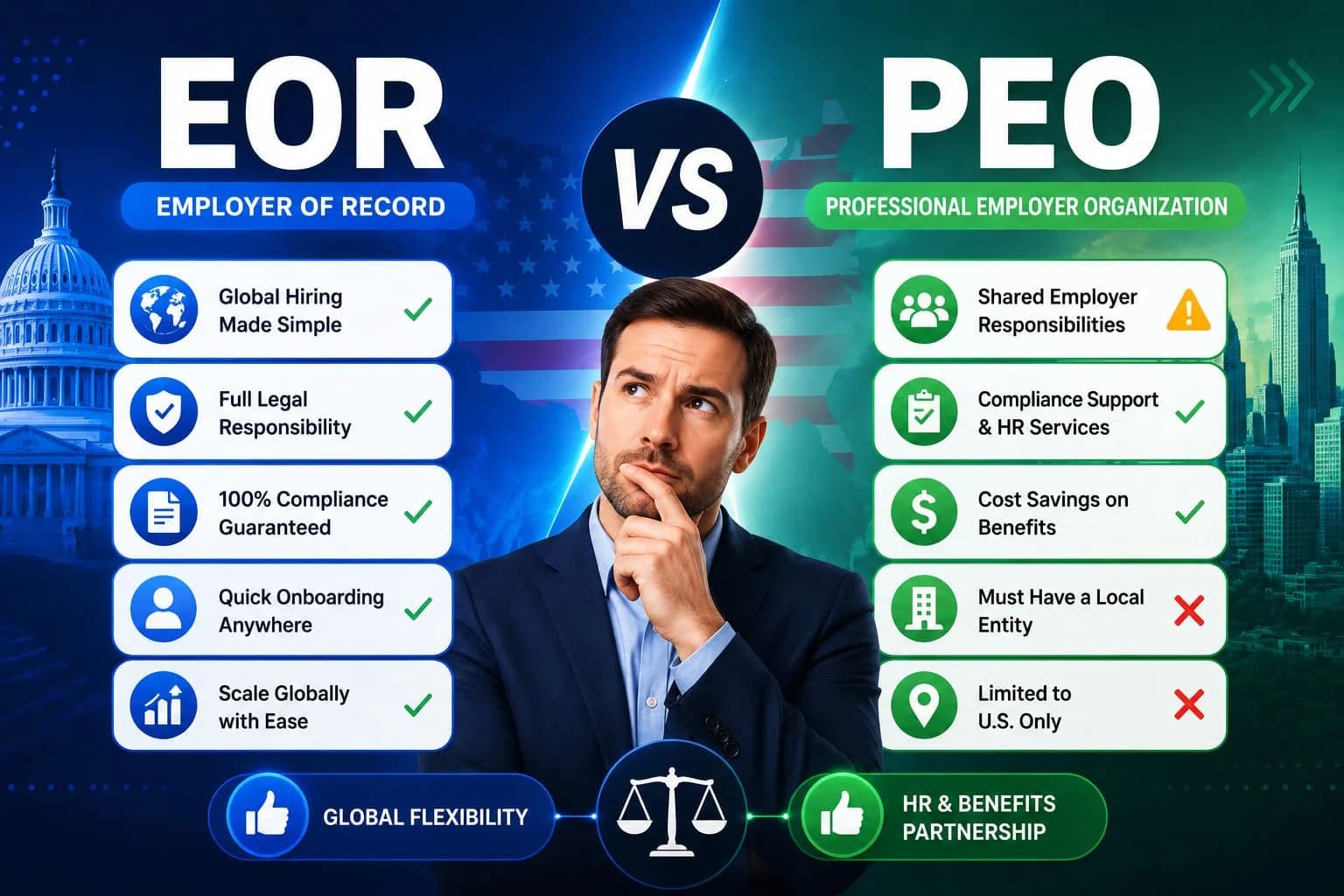
An EOR becomes the legal employer of the worker, while a PEO generally operates through a co-employment relationship with your company.
For a US company that already employs workers domestically, a PEO can provide an efficient way to outsource many HR functions. For a US company looking to hire employees in another country where it does not have a legal entity, an EOR is often the more practical option.
Understanding these differences is essential before deciding which model is right for your business.
EOR vs PEO at a Glance
Here is a simplified comparison:
Feature | EOR | PEO |
|---|---|---|
Legal employer | EOR | Client remains an employer under co-employment |
Local entity typically required | No | Yes |
Payroll administration | Yes | Yes |
Benefits administration | Usually | Usually |
HR support | Usually | Yes |
Compliance support | Yes | Yes |
International hiring | Major use case | Generally requires client entity |
Domestic US HR outsourcing | Possible, but not primary advantage | Major use case |
Best for | Hiring where you lack an entity | Outsourcing HR for an existing workforce |
The right choice therefore depends heavily on where you are hiring and whether your business already has the legal infrastructure to employ workers there.
What Is an Employer of Record?
An Employer of Record (EOR) is an organization that legally employs workers on behalf of another company.
The EOR appears as the legal employer on employment documentation and handles many of the administrative responsibilities associated with employment.
Depending on the country and provider, these responsibilities can include:
Employment contracts
Payroll processing
Tax withholding
Statutory contributions
Employee benefits
Payslips
Leave administration
Employment compliance
Onboarding
Offboarding
Final pay and termination administration
Your company still manages the employee's actual work.
You decide what the employee does, which projects they work on, their responsibilities, and how they fit into your organization. The EOR handles the legal and administrative employment infrastructure.
This arrangement is particularly useful when a US company wants to hire an employee in another country without establishing its own local entity.
What Is a PEO?
A Professional Employer Organization (PEO) provides HR services through a co-employment arrangement.
Unlike an EOR, the PEO generally does not replace your company as the employer. Instead, your company and the PEO divide certain employment responsibilities.
The PEO may handle functions such as:
Payroll
Payroll tax administration
Benefits
Workers' compensation
HR administration
Compliance support
Employee onboarding
HR documentation
Your company continues to employ and manage its workers.
For this reason, PEOs are particularly popular among small and midsized US companies that already employ workers but want to outsource some of the complexity of HR administration.
The Biggest Difference: Who Is the Legal Employer?
The most important distinction between an EOR and a PEO is the employment relationship.
With an EOR, the EOR is the legal employer.
With a PEO, your business remains an employer and enters into a co-employment arrangement with the PEO.
This distinction has major implications when hiring internationally.
Imagine a US consulting company wants to hire its first employee in the Philippines.
If the company does not have a Philippine legal entity, it generally cannot simply use a traditional PEO arrangement to solve that problem.
An EOR can provide the local employment infrastructure instead.
The structure becomes:
US Company → Philippine EOR → Philippine Employee
The US company manages the employee's work while the EOR manages the formal local employment relationship.
Advantages of an EOR
1. Hire Internationally Without Establishing an Entity
This is one of the biggest advantages of an EOR.
Establishing a subsidiary in another country can involve incorporation, banking, accounting, tax registration, payroll registration, government reporting, and ongoing compliance.
An EOR allows companies to begin hiring without building all of this infrastructure first.
2. Faster Entry Into New Markets
An EOR can be useful when a company wants to test a new country before making a major investment.
Instead of establishing an entity before hiring the first employee, the company can build a small team and determine whether the market makes sense.
3. Local Employment Expertise
Employment rules vary considerably between countries.
An EOR should understand the employment requirements of the jurisdiction in which it operates and administer payroll and employment according to applicable local requirements.
4. Simplified International Payroll
International payroll can involve local taxes, statutory contributions, benefits, holidays, leave requirements, and other country-specific obligations.
An EOR provides infrastructure for administering these requirements.
5. Useful for Small International Teams
If you want to hire only one or a few employees in a country, establishing an entire subsidiary may be difficult to justify.
An EOR turns much of that infrastructure into a per-employee service.
Disadvantages of an EOR
1. Higher Cost Per Employee
EOR providers generally charge a fee for each employee.
For a small international team, this can be significantly easier than maintaining a foreign entity. As the workforce grows, however, the cumulative EOR fees can become substantial.
2. Less Direct Control Over Employment Administration
Because another organization is the legal employer, some employment processes must go through the EOR.
Changes to contracts, benefits, compensation, and termination may require coordination with the provider.
3. Employee Experience Depends Partly on the Provider
Payroll, employment documentation, HR support, and certain employee questions may be handled by the EOR.
Choosing a poor provider can therefore affect your employees' experience.
4. It May Not Be the Best Long-Term Solution at Scale
If you eventually employ dozens or hundreds of people in one country, establishing your own entity may become more economical and give you greater control.
Advantages of a PEO
1. Outsource HR Administration
A PEO can take over many time-consuming administrative functions while your company continues to employ and manage its workforce.
This can be particularly valuable for smaller companies without a large internal HR department.
2. Access to Employee Benefits
PEOs may help smaller businesses access and administer employee benefit programs that would otherwise be difficult or expensive to manage independently.
3. Payroll Administration
The PEO can handle payroll processing and related administrative responsibilities, reducing the burden on internal teams.
4. HR and Compliance Support
PEOs typically provide HR expertise and resources that can help companies manage employment policies and administrative compliance.
5. Scalability
As a company's workforce grows, the PEO can handle increasing payroll and HR administration without requiring the business to build a large HR department immediately.
Disadvantages of a PEO
1. Your Company Still Needs to Be an Employer
A PEO does not generally solve the problem of hiring an employee in a country where your company has no legal employment infrastructure.
This is one of the biggest differences between a PEO and an EOR.
2. Co-Employment Can Add Complexity
Responsibilities are divided between your company and the PEO.
Businesses should clearly understand which organization is responsible for each HR and employment function.
3. Less Flexibility in Benefits and HR Systems
PEOs typically operate standardized systems and benefit structures.
Businesses that want highly customized HR processes may find these arrangements restrictive.
4. Fees Increase With Your Workforce
Like EOR services, PEO costs can increase as the number of employees grows.
Companies should compare PEO fees with the cost of building internal HR capabilities as they scale.
EOR vs PEO for International Hiring
International hiring is where the distinction becomes especially important.
Suppose your US company wants to hire someone in the Philippines but does not have a Philippine corporation.
Using an EOR can provide a way to employ that person through an established local employment structure.
The EOR can administer applicable Philippine employment requirements, which may include:
Payroll
Income tax withholding
Social Security System (SSS) contributions
PhilHealth contributions
Pag-IBIG contributions
13th-month pay
Applicable holiday pay
Leave administration
Employment documentation
Your US company manages the employee's work while the Philippine EOR handles the local employment administration.
If your company already has a Philippine entity capable of employing workers directly, you may instead consider local payroll outsourcing, HR outsourcing, or another appropriate service model.
EOR vs PEO for US Employees
The calculation is different when your workers are already employed by your US business.
Suppose you operate a small US company with 40 employees and want help managing payroll, benefits, workers' compensation, and HR administration.
You do not need another organization to become the legal employer simply because you want to outsource HR tasks.
A PEO may therefore be the more natural option.
The company maintains its workforce while using the PEO's HR infrastructure and services.
A simple way to think about the distinction is:
PEO: "Help me manage employees I can already legally employ."
EOR: "Help me employ someone where I don't have the infrastructure to employ them directly."
There are exceptions and jurisdiction-specific details, but this distinction is a useful starting point for US employers.
EOR vs PEO Costs
There is no universal answer to whether an EOR or PEO is cheaper.
The pricing structures are different and vary between providers.
EOR providers commonly charge either a fixed monthly fee per employee or a fee based on payroll or employment costs.
Additional EOR expenses may include:
Onboarding fees
Security deposits
Benefits
Insurance
Foreign-exchange fees
International payment fees
Offboarding fees
Termination-related costs
PEO providers may charge a fixed per-employee fee or a percentage of payroll, depending on the provider and services included.
When comparing costs, businesses should evaluate the total cost of employment and administration, rather than comparing only advertised monthly fees.
For international hiring, the comparison should also include the cost of establishing and maintaining your own foreign entity.
EOR vs PEO: Which Should You Choose?
The decision becomes easier when you start with the problem your company is trying to solve.
Consider an EOR if:
You want to hire internationally.
You do not have a legal entity in the employee's country.
You are testing a new international market.
You are hiring your first few employees overseas.
You want local payroll and employment administration handled for you.
Establishing a foreign subsidiary does not yet make financial sense.
Consider a PEO if:
You already employ workers directly.
You want to outsource HR administration.
You need help managing payroll and benefits.
You want additional HR and compliance support.
You want to strengthen your HR capabilities without building a large internal HR department.
For some businesses, the answer can also be both.
A US company might use a PEO for its domestic workforce while using an EOR to employ workers in countries where it does not have local entities.
The two models solve different problems and do not necessarily have to be mutually exclusive.
EOR vs PEO vs ASO
Another model US employers may encounter is an Administrative Services Organization (ASO).
An ASO provides outsourced HR services but does not typically enter into a co-employment relationship.
A simplified comparison is:
EOR | PEO | ASO | |
|---|---|---|---|
Legal employer | EOR | Client/co-employment structure | Client |
Payroll services | Yes | Yes | Often |
HR administration | Yes | Yes | Yes |
Benefits administration | Often | Common | Can be |
Co-employment | No | Yes | No |
International hiring without local entity | Major use case | Generally no | No |
An ASO can therefore be useful when a company wants HR support but does not want a co-employment arrangement.
Questions to Ask Before Choosing an EOR or PEO
Before signing with either type of provider, ask:
Who will legally employ the workers?
Do we need our own entity?
What payroll services are included?
Which compliance responsibilities does the provider assume?
How are employee benefits handled?
What is the total cost per employee?
Are there setup fees or deposits?
How are employees onboarded?
How are terminations handled?
What HR support is available?
Can we leave the service easily?
What happens to employees if we change providers?
For international EOR arrangements, also ask whether the provider directly owns the local entity employing your workers or uses another local partner.
Frequently Asked Questions
What is the main difference between an EOR and a PEO?
An EOR becomes the legal employer of workers on behalf of the client company. A PEO generally operates through a co-employment relationship in which the client remains an employer.
Is an EOR better than a PEO?
Neither is universally better. They solve different problems. An EOR is generally more suitable when a company needs to hire in a jurisdiction where it lacks an employing entity. A PEO is generally more suitable for businesses that can already employ their workers but want to outsource HR functions.
Do I need a legal entity to use a PEO?
The PEO model generally assumes that the client company is already able to employ the workers. Companies hiring in countries where they lack an entity commonly consider an EOR instead.
Can a US company use an EOR to hire in the Philippines?
An EOR can provide a structure for a US company to employ workers in the Philippines without establishing its own Philippine entity, subject to the provider's capabilities and applicable local requirements.
Can a company use both an EOR and a PEO?
Yes. For example, a company could use a PEO for its US employees and an EOR for employees in countries where it does not have legal entities.
What is the difference between PEO and ASO?
A PEO generally enters into a co-employment arrangement with the client. An ASO provides administrative HR services while the client remains responsible for the employment relationship.
Making the Right Choice
The choice between an EOR and a PEO ultimately comes down to what your business needs.
If your US company already has the legal ability to employ its workers and primarily needs help with payroll, benefits, and HR administration, a PEO may be the better fit.
If your company wants to hire employees in another country without establishing a local entity, an EOR may provide the infrastructure needed to make that possible.
For US businesses expanding internationally, this distinction is particularly important.
Instead of asking simply, "Is an EOR or PEO better?", ask:
"Do we need someone to help manage employees we already employ, or do we need someone to legally employ workers on our behalf?"
The answer to that question will usually point you toward the right model.
You might also like
More guides on Employer of Records.
Navigating Employer of Record Payroll Services: A Comprehensive Guide
Explore the benefits of Employer of Record payroll services and how they can streamline your global hiring process.
How an Employer of Record in the Philippines Transformed Hiring
Discover how a U.S. company leveraged an Employer of Record in the Philippines to streamline hiring and payroll, boosting efficiency and reducing costs.
PEO vs ASO: Weighing Pros and Cons for Employers
Deciding between a PEO and an ASO? Explore the pros and cons to make the best choice for your business.
Step-by-Step Guide to Employer of Record in the Philippines
Learn how to navigate Employer of Record services in the Philippines with our detailed step-by-step guide, perfect for understanding EOR and its benefits.
Latest Virtual Assistant Jobs
Fresh remote VA roles — apply directly