
PEO vs ASO: Weighing Pros and Cons for Employers
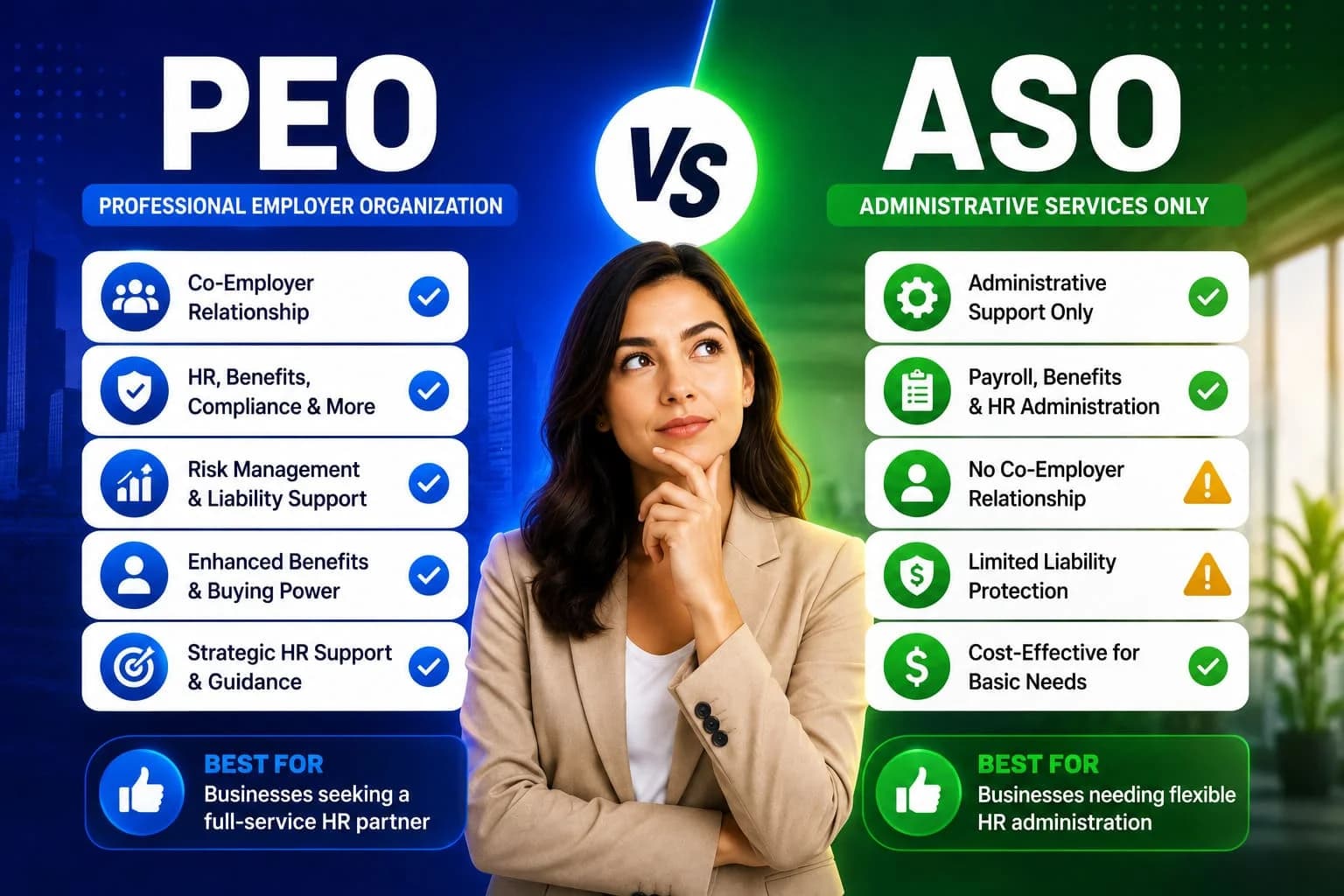
Quick Answer
Deciding between a PEO and an ASO? Explore the pros and cons to make the best choice for your business.
Table of Contents
- 1.PEO vs ASO at a Glance
- 2.What Is a PEO?
- 3.What Is an ASO?
- 4.The Biggest Difference: Co-Employment
- 5.Advantages of Using a PEO
- 6.Disadvantages of Using a PEO
- 7.Advantages of Using an ASO
- 8.Disadvantages of Using an ASO
- 9.PEO vs ASO: Cost Comparison
- 10.Why Percentage-of-Payroll Pricing Deserves Attention
- 11.PEO vs ASO: Who Carries the Risk?
- 12.What About Certified PEOs?
- 13.Which Businesses Benefit Most From a PEO?
- 14.Which Businesses Benefit Most From an ASO?
- 15.PEO vs ASO vs EOR
- 16.Can a Company Move From a PEO to an ASO?
- 17.Questions to Ask a PEO
- 18.Questions to Ask an ASO
- 19.PEO vs ASO: Decision Framework
- 20.Frequently Asked Questions
- 21.PEO or ASO: Which Should You Choose?
PEO vs ASO: Weighing Pros and Cons for Employers
Outsourcing HR administration can help businesses reduce internal workload, manage payroll, administer employee benefits, and navigate increasingly complex employment requirements.
Two common options are a Professional Employer Organization (PEO) and an Administrative Services Organization (ASO).
At first glance, the services can look similar. Both may provide payroll processing, HR administration, compliance support, and other workforce services.
The fundamental difference is the employment relationship:
A PEO enters into a co-employment relationship with the client, while an ASO provides administrative services without becoming a co-employer.
That distinction affects liability, employee benefits, workers' compensation, control, pricing, and the responsibilities that remain with your company.
For employers deciding between a PEO and ASO, neither model is automatically better. The right choice depends primarily on how much HR infrastructure you already have and how much responsibility you want to outsource.
PEO vs ASO at a Glance
Feature | PEO | ASO |
|---|---|---|
Co-employment | Yes | No |
Client remains employer | Yes, under co-employment | Yes |
Payroll processing | Usually | Usually |
Payroll tax administration | Usually | Available |
HR administration | Comprehensive | Customizable |
Benefits administration | Major advantage | Available, but structured differently |
Workers' compensation | Often integrated | May be administered |
Compliance support | Extensive | Advisory/administrative |
Employer liability | Responsibilities divided under agreement | Primarily remains with client |
Service flexibility | Usually bundled | Usually more customizable |
Best suited for | Companies wanting comprehensive HR outsourcing | Companies wanting to retain more control |
The most important question is therefore not simply which provider costs less.
Employers should ask:
Do we want an integrated co-employment relationship, or do we primarily want someone to administer HR functions on our behalf?
What Is a PEO?
A Professional Employer Organization provides HR services through a co-employment relationship.
The business continues to manage employees' day-to-day work, including hiring decisions, responsibilities, performance, schedules, and business operations.
The PEO assumes responsibility for certain administrative employment functions under the service agreement.
These commonly include:
Payroll processing
Payroll tax administration
Employee benefits
Workers' compensation
HR administration
Compliance assistance
Employee onboarding
HR documentation
Unemployment administration
Employee handbooks and policies
The PEO model is particularly common among small and midsized businesses that want access to substantial HR infrastructure without building an equally large internal HR department.
What Is an ASO?
An Administrative Services Organization also provides outsourced HR services, but without establishing a co-employment relationship.
Your company remains responsible for employing its workers.
The ASO effectively acts as an external administrative HR provider.
Services can include:
Payroll processing
Payroll tax administration
Benefits administration
HR technology
Compliance support
Employee onboarding
HR documentation
Time and attendance
Recruiting support
HR consulting
Because there is no co-employment relationship, businesses generally retain more responsibility and control.
This can make an ASO particularly attractive to companies that already have HR capabilities but want to outsource repetitive or specialized administrative functions.
The Biggest Difference: Co-Employment
The defining difference between a PEO and an ASO is co-employment.
Under a PEO arrangement, certain employer responsibilities are allocated between the client company and the PEO.
The PEO may become responsible for areas such as payroll administration, payroll taxes, benefits, and workers' compensation according to the agreement.
The client continues managing the actual business.
With an ASO, there is no equivalent co-employment arrangement.
The ASO performs services for the employer, but the employer retains the underlying employment responsibilities.
A simple way to understand the distinction is:
PEO: "Become our HR co-employer and help manage our workforce infrastructure."
ASO: "Help us administer HR while we retain the employment relationship."
Advantages of Using a PEO
1. Comprehensive HR Infrastructure
One of the biggest advantages of a PEO is the breadth of services available through a single provider.
Payroll, benefits, workers' compensation, HR support, and other services can be integrated into one system.
For a small business without a substantial HR department, this can simplify workforce administration considerably.
2. Access to Employee Benefits
PEOs can provide small and midsized businesses with access to employee benefit arrangements through the PEO structure.
This can help smaller employers offer competitive benefits without independently building and administering every program.
According to the National Association of Professional Employer Organizations (NAPEO), PEOs provide services to hundreds of thousands of small and midsized businesses in the United States. Employers evaluating the model can review industry information directly through NAPEO.
3. Payroll Administration
Payroll can consume significant administrative resources as a company grows.
A PEO can handle functions such as:
Payroll calculations
Direct deposits
Payroll tax administration
Employee payroll records
Year-end tax documentation
This allows internal teams to spend less time on routine payroll administration.
4. Compliance Support
Employment requirements can vary between federal, state, and local jurisdictions.
PEOs generally maintain dedicated HR and compliance resources that smaller companies might not otherwise have internally.
However, using a PEO does not mean that the client company can ignore employment compliance entirely. Businesses should understand precisely which responsibilities are allocated to each party in their agreement.
5. Workers' Compensation Administration
Workers' compensation can also be integrated into some PEO arrangements.
The PEO may assist with insurance administration, claims processes, workplace safety programs, and related functions.
6. Reduced Internal HR Workload
Perhaps the simplest PEO benefit is that businesses can outsource a large portion of routine HR administration.
Instead of building separate internal teams for payroll, benefits, compliance, and other functions, companies can access these capabilities through the PEO.
Disadvantages of Using a PEO
PEOs also have limitations.
1. Co-Employment Is Not Suitable for Every Company
Some employers prefer to retain direct control over virtually every aspect of HR administration.
The PEO model requires the company to operate within a shared employment framework.
Businesses should therefore understand exactly which responsibilities the PEO assumes before entering an agreement.
2. Less Flexibility
PEO services are frequently provided as an integrated package.
This can be convenient, but businesses may have less freedom to choose separate providers for payroll, benefits, workers' compensation, and other services.
3. Benefits May Be Tied to the PEO
Changing PEOs can potentially affect benefits arrangements and other HR systems.
Employers should consider switching costs when evaluating long-term contracts.
4. Pricing Can Become Significant
PEOs commonly charge either:
A fixed amount per employee
A percentage of payroll
A combination of service charges
The total cost can become substantial as headcount and payroll grow.
5. Provider Dependence
When payroll, benefits, HR technology, and other functions are consolidated with one provider, service problems can affect several parts of the employee experience simultaneously.
Provider quality therefore matters considerably.
Advantages of Using an ASO
1. Greater Employer Control
An ASO does not establish a co-employment relationship.
The employer maintains control over its employment structure while outsourcing selected administrative responsibilities.
This can be particularly attractive to businesses that already have experienced HR leadership.
2. More Customizable Services
ASOs can allow companies to choose the services they actually need.
For example, a business might outsource:
Payroll + benefits administration + compliance support
while continuing to manage recruiting, employee relations, compensation strategy, and other HR functions internally.
This can provide more flexibility than a comprehensive PEO arrangement.
3. Easier Integration With Existing HR Teams
A company does not necessarily need to replace its existing HR infrastructure when adopting an ASO.
Instead, the ASO can supplement it.
For example:
Internal HR team
Handles strategy, hiring, culture, performance, and employee relations.
ASO
Handles payroll, benefits administration, HR systems, and repetitive administrative work.
This division can be particularly effective for growing companies.
4. Potentially Lower Costs
Because businesses can purchase a narrower range of services, an ASO can potentially cost less than a comprehensive PEO arrangement.
However, this is not guaranteed.
Employers should compare total costs based on the actual services required rather than assuming that an ASO will always be cheaper.
5. Greater Choice of Benefits and Insurance Providers
Businesses may have more flexibility to maintain their own insurance policies, benefit plans, and other relationships rather than adopting those associated with a PEO.
This can become increasingly important as companies grow.
Disadvantages of Using an ASO
1. Employer Retains More Responsibility
The flexibility of the ASO model comes with a tradeoff.
The employer remains responsible for its employment relationship and associated obligations.
The ASO can provide administrative and professional support, but outsourcing a task does not necessarily transfer the underlying employer responsibility.
2. Requires More Internal HR Capability
A company with no HR expertise may find a highly customized ASO arrangement more difficult to manage than an integrated PEO.
Someone internally still needs to determine:
HR strategy
Policies
Benefits decisions
Employee relations
Employment practices
Vendor management
The ASO can assist, but the employer remains at the center of the HR operation.
3. Benefits Purchasing Power May Differ
One of the attractions of certain PEO arrangements is access to benefits through the PEO structure.
An ASO does not operate under the same co-employment model, so benefit arrangements work differently.
Employers should compare actual insurance and benefit quotations rather than assuming equivalent pricing.
4. Multiple Vendors May Still Be Necessary
An ASO may handle payroll and HR administration while the employer maintains separate relationships for insurance, retirement plans, workers' compensation, or other services.
That can provide flexibility but may also increase administrative complexity.
PEO vs ASO: Cost Comparison
There is no universal price difference between PEO and ASO services.
The total cost depends on:
Number of employees
Total payroll
Services required
Benefits
Workers' compensation
HR technology
Compliance support
Insurance arrangements
Provider
Contract structure
Percentage-of-Payroll PEO Pricing
Suppose a PEO charged an illustrative 3% of payroll.
For a company with $1 million in annual payroll:
$1,000,000 × 3% = $30,000 per year
At $5 million:
$5,000,000 × 3% = $150,000 per year
At $10 million:
$10,000,000 × 3% = $300,000 per year
These are examples only. They are not intended to represent an industry-standard PEO rate.
They illustrate why employers should understand whether their provider uses percentage-based or fixed per-employee pricing.
Per-Employee Pricing
A provider might instead charge a fixed administrative fee.
For example, an illustrative $150 per employee per month would produce:
Employees | Monthly Cost | Annual Cost |
|---|---|---|
10 | $1,500 | $18,000 |
25 | $3,750 | $45,000 |
50 | $7,500 | $90,000 |
100 | $15,000 | $180,000 |
250 | $37,500 | $450,000 |
Again, these figures illustrate how the pricing model works rather than representing a quoted market price.
When comparing PEO and ASO providers, employers should request actual quotations based on their payroll, headcount, benefits, workers' compensation requirements, and requested services.
Why Percentage-of-Payroll Pricing Deserves Attention
Percentage pricing can create substantially different fees for companies with the same number of employees.
Consider two 50-person businesses.
Company A
50 employees earning an average of $40,000.
Annual payroll: $2 million
At an illustrative 3% administrative fee:
$60,000
Company B
50 employees earning an average of $100,000.
Annual payroll: $5 million
At the same illustrative 3%:
$150,000
Both companies have exactly 50 employees.
But Company B pays 2.5 times as much under percentage-based pricing.
Employers should therefore consider whether a per-employee administrative fee or percentage-of-payroll model makes more economic sense for their workforce.
PEO vs ASO: Who Carries the Risk?
This is one of the most important areas to understand.
A PEO does not simply eliminate all employment liability for the client.
Instead, responsibilities are allocated through the co-employment relationship and service agreement.
The client company still controls major aspects of the workplace and remains responsible for its own actions and obligations.
An ASO generally does not become a co-employer. It provides administrative services while the client retains the underlying employment relationship.
Businesses should therefore avoid choosing a PEO solely because they believe it will transfer all employment risk to another organization.
The actual agreement matters.
What About Certified PEOs?
US employers evaluating PEOs may encounter the term Certified Professional Employer Organization, or CPEO.
The Internal Revenue Service operates a voluntary certification program for qualifying PEOs.
According to the IRS, a CPEO must satisfy requirements involving tax status, background, experience, business location, financial reporting, bonding, and other criteria.
Employers can learn about the program and search the IRS's published CPEO information through the Internal Revenue Service.
Certification does not automatically mean that a particular PEO is the right provider for every company, but CPEO status is one factor employers can consider during due diligence.
Which Businesses Benefit Most From a PEO?
A PEO may be particularly attractive when a company:
Has limited internal HR resources
Wants an integrated HR solution
Needs payroll administration
Wants assistance administering employee benefits
Wants HR and compliance resources
Needs workers' compensation support
Prefers one provider for multiple HR functions
Is comfortable with a co-employment arrangement
Consider a 30-person company without a dedicated HR department.
The owner or operations manager may currently be responsible for payroll, benefits questions, onboarding, employee documentation, and compliance.
Using a PEO can consolidate much of that work.
The value in this scenario is not simply the cost of the PEO.
The company must also consider the cost of the internal employees, systems, professional services, and management time that would otherwise be required.
Which Businesses Benefit Most From an ASO?
An ASO may be particularly attractive when a company:
Already has an internal HR team
Wants to retain greater control
Does not want co-employment
Needs payroll administration
Wants HR technology
Needs benefits administration
Wants specific HR functions outsourced
Has established insurance and benefit relationships
Prefers customizable services
Consider a 150-person company with an HR director and several HR employees.
The company may not need another organization to provide its entire HR infrastructure.
It may simply want to remove repetitive payroll and benefits administration from the internal team's workload.
An ASO can provide that administrative layer while the internal HR department continues to control strategy.
PEO vs ASO vs EOR
Employers researching PEOs and ASOs may also encounter Employer of Record services.
An EOR solves a different problem.
PEO | ASO | EOR | |
|---|---|---|---|
Co-employment | Yes | No | No |
Client employs worker | Under co-employment | Yes | No |
Provider is legal employer | Not in the same way as an EOR | No | Yes |
Payroll administration | Yes | Yes | Yes |
HR administration | Yes | Yes | Yes |
International hiring without client entity | Generally not the purpose | No | Major use case |
A US company might therefore use:
PEO: to manage HR for its US workforce.
ASO: to outsource specific HR functions while maintaining greater control.
EOR: to hire employees in countries where it does not have an employing entity.
These services overlap operationally but solve different organizational problems.
Can a Company Move From a PEO to an ASO?
Yes.
A company's HR needs can change as it grows.
A 15-person startup may initially benefit from outsourcing much of its HR infrastructure through a PEO.
Years later, the company might have:
200 employees
An HR director
Payroll specialists
Its own benefit strategy
Internal compliance expertise
At that point, the business may determine that it no longer needs the full PEO model.
Moving to an ASO or bringing certain functions in-house can provide greater control.
The reverse can also happen.
A company struggling with fragmented payroll, benefits, compliance, and HR vendors may decide that consolidating those functions through a PEO provides more value.
Questions to Ask a PEO
Before choosing a PEO, ask:
Are you a certified PEO?
What exactly does the co-employment relationship cover?
Which responsibilities remain with our company?
How is pricing calculated?
Is pricing based on payroll or headcount?
Which employee benefits are available?
How are workers' compensation costs calculated?
Which HR services are included?
What services cost extra?
Which HR technology platform will employees use?
What happens if we terminate the agreement?
What happens to employee benefits if we leave?
How is our employee data exported?
What implementation costs apply?
Questions to Ask an ASO
Before choosing an ASO, ask:
Which HR functions can we outsource?
Can we purchase services individually?
How is pricing calculated?
Can we keep our current benefits?
Can we keep our current insurance providers?
Who handles payroll tax filings?
What compliance support is included?
Which responsibilities remain entirely with us?
Can the service integrate with our existing HR software?
Are there minimum employee requirements?
What implementation fees apply?
Can we add or remove services later?
How do we retrieve our data if we change providers?
PEO vs ASO: Decision Framework
The choice becomes easier when employers evaluate three questions.
1. How Much HR Infrastructure Do You Already Have?
Very little internal HR capability
A PEO may provide more value because it offers a more comprehensive HR structure.
Established HR department
An ASO may make more sense because the company can outsource administrative work while retaining its existing expertise.
2. How Much Control Do You Want?
Comfortable with co-employment and standardized services
Consider a PEO.
Want to maintain the employment relationship and customize vendors and services
Consider an ASO.
3. What Are You Actually Trying to Outsource?
If the answer is:
"Most of HR administration"
a PEO deserves consideration.
If the answer is:
"Payroll and a few administrative functions"
an ASO may be more appropriate.
Frequently Asked Questions
What is the main difference between a PEO and an ASO?
A PEO establishes a co-employment relationship with the client company, while an ASO provides administrative HR services without becoming a co-employer.
Is an ASO cheaper than a PEO?
Not necessarily.
ASOs can potentially cost less because businesses may purchase only the services they require. Actual costs depend on headcount, payroll, benefits, services, insurance, and provider pricing.
Does a PEO become the legal employer?
A PEO enters into a co-employment relationship and assumes certain employer responsibilities according to the agreement. This should not be confused with an Employer of Record arrangement, where the EOR becomes the legal employer for the workers employed through it.
Does an ASO process payroll?
Many ASOs provide payroll processing and payroll administration services. Exact capabilities vary by provider.
Can an ASO provide employee benefits?
ASOs can provide benefits administration, but the underlying benefit and insurance arrangements differ from the PEO model.
Does a PEO eliminate employer liability?
No.
A PEO can assume or share certain responsibilities under the co-employment agreement, but the client company retains responsibility for many aspects of employment and workplace management.
What is a CPEO?
A Certified Professional Employer Organization is a PEO that has received certification under the IRS's voluntary CPEO program after meeting applicable requirements.
Which is better for a small business?
A PEO may be attractive to a small company with little internal HR infrastructure because it can provide a broad range of integrated services.
An ASO may be more appropriate for a business that already has HR capabilities and primarily needs administrative support.
PEO or ASO: Which Should You Choose?
The decision between a PEO and an ASO ultimately comes down to the type of HR relationship your business wants.
A PEO can be attractive when you want comprehensive HR infrastructure, benefits administration, payroll, workers' compensation support, and other services integrated through a co-employment model.
An ASO can be attractive when you already have some HR infrastructure and want to outsource specific administrative functions without entering a co-employment relationship.
Neither approach is inherently better.
For a 20-person company with no HR department, the comprehensive nature of a PEO may provide significant value.
For a 200-person company with an experienced HR team, an ASO may provide the flexibility needed to remove administrative work while keeping strategic HR decisions in-house.
The key is to compare more than the monthly service fee.
Evaluate control, co-employment, benefits, liability, internal HR capabilities, pricing structure, technology, and the exact responsibilities included in the contract.
That provides a much stronger basis for deciding whether a PEO or ASO is the right fit for your business.
You might also like
More guides on Employer of Records.
Navigating Employer of Record Payroll Services: A Comprehensive Guide
Explore the benefits of Employer of Record payroll services and how they can streamline your global hiring process.
How an Employer of Record in the Philippines Transformed Hiring
Discover how a U.S. company leveraged an Employer of Record in the Philippines to streamline hiring and payroll, boosting efficiency and reducing costs.
EOR vs PEO: Weighing the Pros and Cons for US Employers
Discover the pros and cons of EOR vs PEO for US employers. Understand key differences and make informed decisions for your business.
Step-by-Step Guide to Employer of Record in the Philippines
Learn how to navigate Employer of Record services in the Philippines with our detailed step-by-step guide, perfect for understanding EOR and its benefits.
Latest Virtual Assistant Jobs
Fresh remote VA roles — apply directly