
Understanding Employer Name: Key Differences and Roles
Quick Answer
Explore the role of an employer in the Philippines, including key differences and services like EOR.
Table of Contents
- 1.What Does Employer Name Mean?
- 2.What Should I Put for Employer Name?
- 3.Is Employer Name the Same as Company Name?
- 4.Employer Name vs. Employee Name
- 5.Employer Name vs. Supervisor Name
- 6.Employer Name vs. Job Title
- 7.Employer Name vs. Business or Brand Name
- 8.Where Can I Find My Employer Name?
- 9.What Is an Employer Name in the Philippines?
- 10.What If I Work for a Foreign Company?
- 11.What Is the Employer Name When You Work Through an EOR?
- 12.What If I Work Through a Staffing Agency?
- 13.What If I Work for a BPO?
- 14.What If I Am Self-Employed?
- 15.What If I Am Unemployed?
- 16.Why Does the Correct Employer Name Matter?
- 17.How to Verify Your Employer Name
- 18.Common Employer Name Mistakes
- 19.Employer vs. EOR vs. PEO vs. ASO
- 20.Frequently Asked Questions
- 21.Employer Name: A Simple Definition
Understanding Employer Name: Key Differences and Roles
An employer name is the official name of the company, organization, or individual that employs you.
If a form asks for your employer name, it usually wants the name of the company you work for. It is not asking for your job title, your supervisor's name, or your own name.
For example:
Employee: Maria Santos
Employer name: ABC Solutions, Inc.
Job title: Customer Support Specialist
Supervisor: John Smith
In this case, ABC Solutions, Inc. is the employer name.
For most workers, the answer is straightforward. But it can get confusing when a company uses a brand name that is different from its legal name, when someone works through a staffing agency, or when a foreign company hires workers in the Philippines through an Employer of Record.
Here is how to tell which name you should use.
What Does Employer Name Mean?
Your employer name identifies the company or organization that employs you.
You may be asked for it when completing:
Job applications
Background checks
Loan applications
Visa applications
Employment verification forms
Government forms
Bank applications
Insurance applications
Rental applications
Tax documents
In simple terms:
Employer name = the name of the organization that employs you.
If you have a regular employment arrangement, the employer's official name will usually appear on your employment contract and other employment records.
What Should I Put for Employer Name?
If a form asks for Employer Name, enter the official name of your employer.
Suppose you work for:
ABC Business Solutions, Inc.
You would enter:
Employer Name: ABC Business Solutions, Inc.
Do not enter:
Employer Name: Customer Service Representative
That is your job title.
You also should not enter your manager's name unless the form specifically asks for your supervisor.
Here is what the different fields might look like:
Field | Example |
|---|---|
Employer Name | ABC Business Solutions, Inc. |
Employee Name | Maria Santos |
Job Title | Customer Service Representative |
Supervisor | John Smith |
Employment Start Date | January 15, 2025 |
Each field tells the organization receiving the form something different about your employment.
Is Employer Name the Same as Company Name?
Usually, but not always.
A business can have a brand name that is different from the legal name of the company.
Imagine that everyone knows your employer as:
Bright Digital
But your employment contract says:
Bright Digital Solutions Philippines, Inc.
Bright Digital may be the brand customers see, while Bright Digital Solutions Philippines, Inc. is the legal company that employs you.
This distinction matters when you are filling out official documents.
If a bank, government agency, background-check company, or other institution asks for your employer, check your official employment records first.
These can include your:
Employment contract
Certificate of employment
Payslip
Tax records
Government contribution records
If you are still unsure, ask your HR or payroll team for the full legal name of your employer.
Employer Name vs. Employee Name
The employer and employee are the two sides of an employment relationship.
The employer is the company, organization, or person that employs the worker.
The employee is the person performing the work in exchange for compensation.
For example:
Employer: ABC Accounting Services, Inc.
Employee: Juan Dela Cruz
ABC Accounting Services, Inc. is the employer name.
Juan Dela Cruz is the employee name.
This may sound obvious, but forms sometimes use only the word Employer, which can cause confusion.
Employer Name vs. Supervisor Name
Your supervisor is not necessarily your employer.
Suppose you work for:
Global Support Philippines, Inc.
Your manager is:
Sarah Williams
If a form asks for your employer name, you would enter:
Global Support Philippines, Inc.
If it asks for your supervisor, you would enter:
Sarah Williams
Your supervisor manages your work. Your employer is the organization that employs you.
Employer Name vs. Job Title
Your job title describes what you do at the company.
For example:
Employer Name: ABC Technologies, Inc.
Job Title: Software Engineer
ABC Technologies, Inc. is the employer.
Software Engineer is the position.
Other job titles could include:
Accountant
Virtual Assistant
Marketing Manager
Customer Support Representative
Executive Assistant
Software Developer
Sales Representative
None of these should be entered as your employer name.
Employer Name vs. Business or Brand Name
This distinction becomes more important when a company operates under a well-known brand.
For example:
Brand: ExampleTech
Legal company: Example Technologies Philippines, Inc.
An employee might tell friends:
"I work for ExampleTech."
That can be completely reasonable in everyday conversation.
But their employment contract may say that Example Technologies Philippines, Inc. is the actual employer.
For formal employment verification, the legal company name is usually the safer choice.
Where Can I Find My Employer Name?
If you are unsure about the official name of your employer, check your employment records.
Employment contract
Start here.
Look for the company identified as your employer or as a party to the employment agreement.
Certificate of employment
Your certificate of employment will usually identify the company issuing the document.
Payslip
Check which company is listed as the employer or payroll entity.
Tax documents
Your employer's information may appear on employment-related tax documents.
SSS, PhilHealth, and Pag-IBIG records
Philippine employees may also find employer information in records connected to government contributions.
If different names appear across these documents, contact HR or payroll and ask:
"What is the full legal name of my employer for official forms and employment verification?"
That should clear up most cases.
What Is an Employer Name in the Philippines?
The meaning is the same in the Philippines.
Your employer name is the name of the company, organization, or individual that employs you.
For formally employed workers, the employer may also have responsibilities involving payroll, tax withholding, and government-mandated contributions.
These can include:
Social Security System or SSS
PhilHealth
Pag-IBIG Fund
The Social Security System maintains employer registration and contribution requirements. Employees and employers can check official information through the SSS website.
PhilHealth and Pag-IBIG also maintain employer registration and contribution systems.
These records can become useful when you need to establish which company officially employs you.
What If I Work for a Foreign Company?
This is where things can become less obvious.
Suppose you live in the Philippines but work for a US company called:
American Software Corp.
You tell people you work for American Software, you attend its meetings, and you report to its managers.
But that does not automatically mean American Software Corp. is your legal employer.
There are several possible arrangements.
The foreign company has a Philippine entity
American Software Corp. may have established a local company:
American Software Corp.
↓
American Software Philippines, Inc.
↓
Employee
In this case, your legal employer may be American Software Philippines, Inc.
You still work for the broader American Software business, but the Philippine entity formally employs you.
You are an independent contractor
You might instead have a contract directly with American Software Corp.
If you are genuinely an independent contractor, American Software may technically be your client rather than your employer.
Check the type of relationship stated in your agreement.
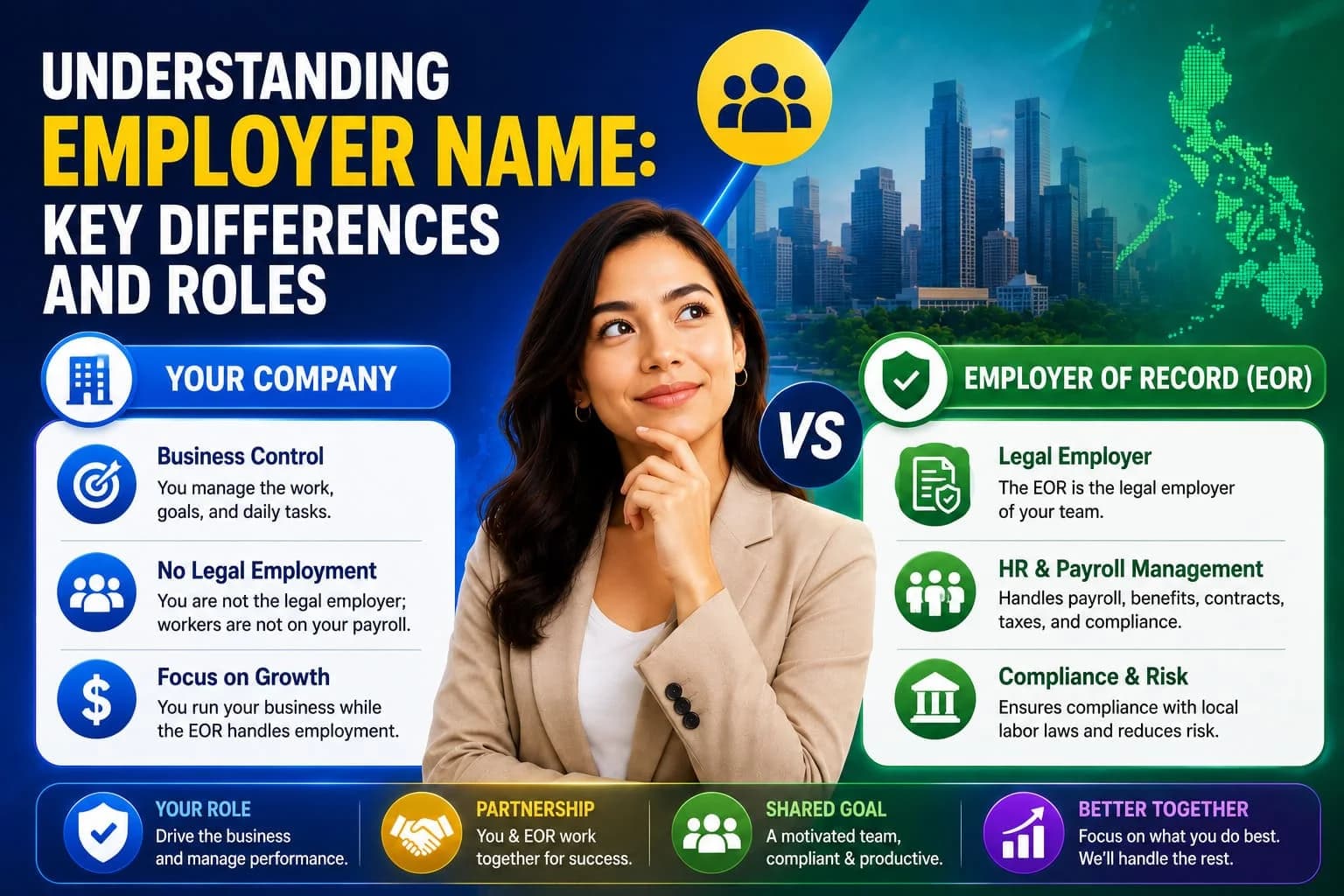
The company uses an Employer of Record
The foreign company may also use an Employer of Record, or EOR, in the Philippines.
This creates another layer in the employment relationship.
What Is the Employer Name When You Work Through an EOR?
An Employer of Record legally employs workers on behalf of another company.
The arrangement could look like this:
US technology company
↓
Philippine Employer of Record
↓
Philippine employee
You might spend every working day with the US company.
You might:
Report to its managers
Use its company email
Attend its meetings
Work on its products
Speak with its customers
Consider yourself part of its team
But your legal employer could still be the Philippine EOR.
For example:
Company you work with: US Software Company
Legal employer: Philippines Employment Solutions, Inc.
Employee: Maria Santos
If an official form specifically asks for your legal employer, Philippines Employment Solutions, Inc. may be the name you need to provide.
This is why workers hired through an EOR should check their employment contracts before completing official employment forms.
The company you work with and the company that legally employs you can be different.
What If I Work Through a Staffing Agency?
A similar situation can happen when you work through a staffing or recruitment agency.
Suppose a staffing company hires you and assigns you to one of its clients.
The arrangement could look like:
Client company
↓
Staffing agency
↓
Worker
You may spend your entire working day supporting the client.
But if the staffing agency employs and pays you, the agency may be the employer you need to list on an official form.
Check your employment contract, certificate of employment, and payslip to confirm.
What If I Work for a BPO?
This is a common situation in the Philippines.
Imagine that you work for a Philippine BPO company but provide customer support exclusively for a US healthcare business.
Your arrangement might be:
Client: US Healthcare Company
Employer: Manila Business Process Solutions, Inc.
Employee: Juan Dela Cruz
You may work with the US healthcare company every day, but Manila Business Process Solutions, Inc. may still be your legal employer.
If an official form asks for your employer name, the BPO company's legal name would generally be the relevant one.
What If I Am Self-Employed?
If you are self-employed, there may not be a separate employer.
Depending on the form, you might enter:
Self-employed
Your own name
Your registered business name
For example:
Employment status: Self-employed
Business name: Maria Santos Digital Services
Check what the form actually asks for.
A field asking for your employer may need a different answer from one asking for your business name or source of income.
What If I Am Unemployed?
If you are not currently employed and a form asks for your current employer, do not invent a company name.
Depending on the form, you may be able to enter:
Unemployed
N/A
Not applicable
None
If it asks for your previous employer, enter the company that employed you during the period being requested.
Why Does the Correct Employer Name Matter?
The correct employer name can matter during background checks and employment verification.
Consider a Filipino software engineer who writes this on a résumé:
American Software Corp.
But a background-check company later finds employment records from:
Philippines Employment Solutions, Inc.
That does not automatically mean the applicant gave false information.
The person may have worked for American Software while being legally employed through a Philippine EOR.
But without an explanation, the difference can create unnecessary questions.
One way to make the relationship clearer on a résumé or background-check form is:
American Software Corp., Software Engineer
Employed through Philippines Employment Solutions, Inc. (Employer of Record)
This shows both the company the employee worked with and the company that handled the formal employment relationship.
How to Verify Your Employer Name
If you need the official name of your employer, follow these steps.
1. Check your employment contract
Look for the company identified as the employer.
2. Check your payslip
See which organization appears on your payroll records.
3. Check your certificate of employment
Look at the legal name of the company issuing the certificate.
4. Check government records
Philippine employees can also review relevant SSS, PhilHealth, Pag-IBIG, and tax records.
5. Ask HR
If you still see several different company names, ask HR for the exact legal employer name you should use for official verification.
Common Employer Name Mistakes
Using your supervisor's name
Incorrect:
Employer Name: Sarah Smith
if Sarah is your manager.
Correct:
Employer Name: ABC Solutions, Inc.
Using your job title
Incorrect:
Employer Name: Virtual Assistant
Correct:
Employer Name: XYZ Services, Inc.
Automatically using the brand name
The brand customers know may not be the company's legal name.
Check your employment records before completing an official form.
Using the foreign client's name when an EOR employs you
If you work for a foreign company through an EOR, the foreign company may not be your legal employer.
Check what the form is asking for and compare it with your employment contract.
Confusing a client with an employer
Freelancers and independent contractors may have clients rather than employers.
If you are a contractor, check the form's instructions rather than describing a client as an employer when that is not your actual relationship.
Employer vs. EOR vs. PEO vs. ASO
Employment and HR terminology can get confusing, particularly for remote workers.
Here is a quick comparison:
Term | What it means |
|---|---|
Employer | The organization or person employing the worker |
EOR | A legal employer that employs workers on behalf of another company |
PEO | An HR provider that generally works through a co-employment arrangement |
ASO | An HR provider offering administrative services without co-employment |
Staffing agency | A company that recruits and may employ workers assigned to clients |
Client | A company receiving services that may or may not be the worker's employer |
These distinctions matter more as Philippine workers increasingly work with companies based overseas.
Frequently Asked Questions
What does employer name mean?
Employer name is the name of the company, organization, or person that employs you.
What should I put for employer name?
Enter the official name of your employer.
If you are unsure, check your employment contract, certificate of employment, payslip, or other official employment records.
Is employer name my boss's name?
No, in most cases.
Your boss is your supervisor or manager. Your employer is the organization that employs you.
Is employer name the same as company name?
Usually, but not always.
A company's brand name may be different from the legal company that employs you.
Is employer name my job title?
No.
Your employer name identifies the organization employing you. Your job title describes your role in that organization.
What if I work for a US company from the Philippines?
Check how you were hired.
You could be employed by the US company, its Philippine subsidiary, a Philippine EOR, a staffing agency, or another local company.
You could also be working as an independent contractor.
Your contract should identify the relationship.
What if my company uses an Employer of Record?
The EOR may be your legal employer even though another company manages your daily work.
Check your employment contract when an official form asks for your legal employer.
What is an employer name on a background check?
The employer name helps the background-check company verify your employment history.
If you worked through an EOR, staffing agency, subsidiary, or company that later changed its name, provide enough information to make the relationship clear.
Where can I find my employer name?
The best place to start is your employment contract.
You can also check your payslip, certificate of employment, tax documents, and applicable government contribution records.
Employer Name: A Simple Definition
In most cases, your employer name is simply the official name of the company or organization that employs you.
If you work directly for a Philippine company, the answer is usually straightforward.
It gets more complicated when you:
Work for a foreign company
Work through an EOR
Work through a staffing agency
Work for a BPO serving a foreign client
Work for a subsidiary
Work under a company with a different brand and legal name
Work as an independent contractor
Are self-employed
If a form asks for your employer name, check your official employment records first.
Your employment contract, certificate of employment, payslip, and government records can help confirm the correct name.
For workers employed through an EOR, staffing agency, or BPO, one distinction is particularly important:
The company you work with every day may not be the same company that legally employs you.
You might also like
More guides on Employer of Records.
Navigating Employer of Record Payroll Services: A Comprehensive Guide
Explore the benefits of Employer of Record payroll services and how they can streamline your global hiring process.
How an Employer of Record in the Philippines Transformed Hiring
Discover how a U.S. company leveraged an Employer of Record in the Philippines to streamline hiring and payroll, boosting efficiency and reducing costs.
EOR vs PEO: Weighing the Pros and Cons for US Employers
Discover the pros and cons of EOR vs PEO for US employers. Understand key differences and make informed decisions for your business.
PEO vs ASO: Weighing Pros and Cons for Employers
Deciding between a PEO and an ASO? Explore the pros and cons to make the best choice for your business.
Latest Virtual Assistant Jobs
Fresh remote VA roles — apply directly