
Understanding the Difference Between Employer and Employee Roles
Quick Answer
Learn the distinct roles of employers and employees in the Philippines, including key differences and responsibilities.
Table of Contents
- 1.What Is an Employer?
- 2.What Is an Employee?
- 3.Employer vs. Employee: The Basic Difference
- 4.What Are the Responsibilities of an Employer?
- 5.What Are the Responsibilities of an Employee?
- 6.Employer vs. Employee SSS Contributions
- 7.Employer vs. Employee in a Simple Payroll Example
- 8.Employer vs. Supervisor: They Are Not the Same
- 9.Employer vs. Company Owner
- 10.Employer vs. Client
- 11.Employee vs. Independent Contractor
- 12.What If You Work for a Foreign Company?
- 13.Employer and Employee Roles Under an Employer of Record
- 14.What About BPO Employees?
- 15.Why the Employer-Employee Difference Matters
- 16.How to Identify Your Employer
- 17.Common Misunderstandings
- 18.Employer vs. Employee at a Glance
- 19.Frequently Asked Questions
- 20.Employer and Employee: The Simple Definition
Understanding the Difference Between Employer and Employee Roles
An employer is a person, company, or organization that hires people to perform work. An employee is the person hired to perform that work in exchange for compensation.
That is the simplest difference between an employer and an employee.
For example, if ABC Accounting Services, Inc. hires Maria Santos as a bookkeeper:
Employer: ABC Accounting Services, Inc.
Employee: Maria Santos
Position: Bookkeeper
The employer provides the job and pays the employee. The employee performs the work required by the job.
But the relationship involves more than salary and assigned tasks. In the Philippines, being classified as an employer or employee can affect payroll, taxes, SSS, PhilHealth, Pag-IBIG, workplace rights, benefits, and how an employment relationship can be ended.
Understanding who the employer is can become especially important when someone works remotely, through a staffing company, for a BPO, or for a foreign business using an Employer of Record.
What Is an Employer?
An employer is a person or organization that employs one or more workers.
In a typical company, the employer is the business that enters into an employment relationship with the employee.
The employer generally determines what work needs to be done and manages the employment relationship.
For example:
Company: Manila Digital Solutions, Inc.
Worker: Juan Dela Cruz
Position: Software Developer
Manila Digital Solutions, Inc. is the employer.
Juan Dela Cruz is the employee.
The company's owner, CEO, or Juan's direct supervisor is not necessarily his employer as an individual. The employer may instead be the legal company that hired him.
This distinction matters when completing employment contracts, government registrations, background checks, and other official documents.
What Is an Employee?
An employee is a person who performs work for an employer in exchange for compensation under an employment relationship.
Employees can work in many different positions.
Examples include:
Accountant
Software developer
Virtual assistant
Nurse
Sales representative
Customer service representative
Marketing specialist
Executive assistant
Operations manager
A person's job title does not determine whether they are an employer or employee.
A marketing manager can still be an employee. A chief technology officer can also be an employee.
What matters is the underlying relationship between the worker and the organization.
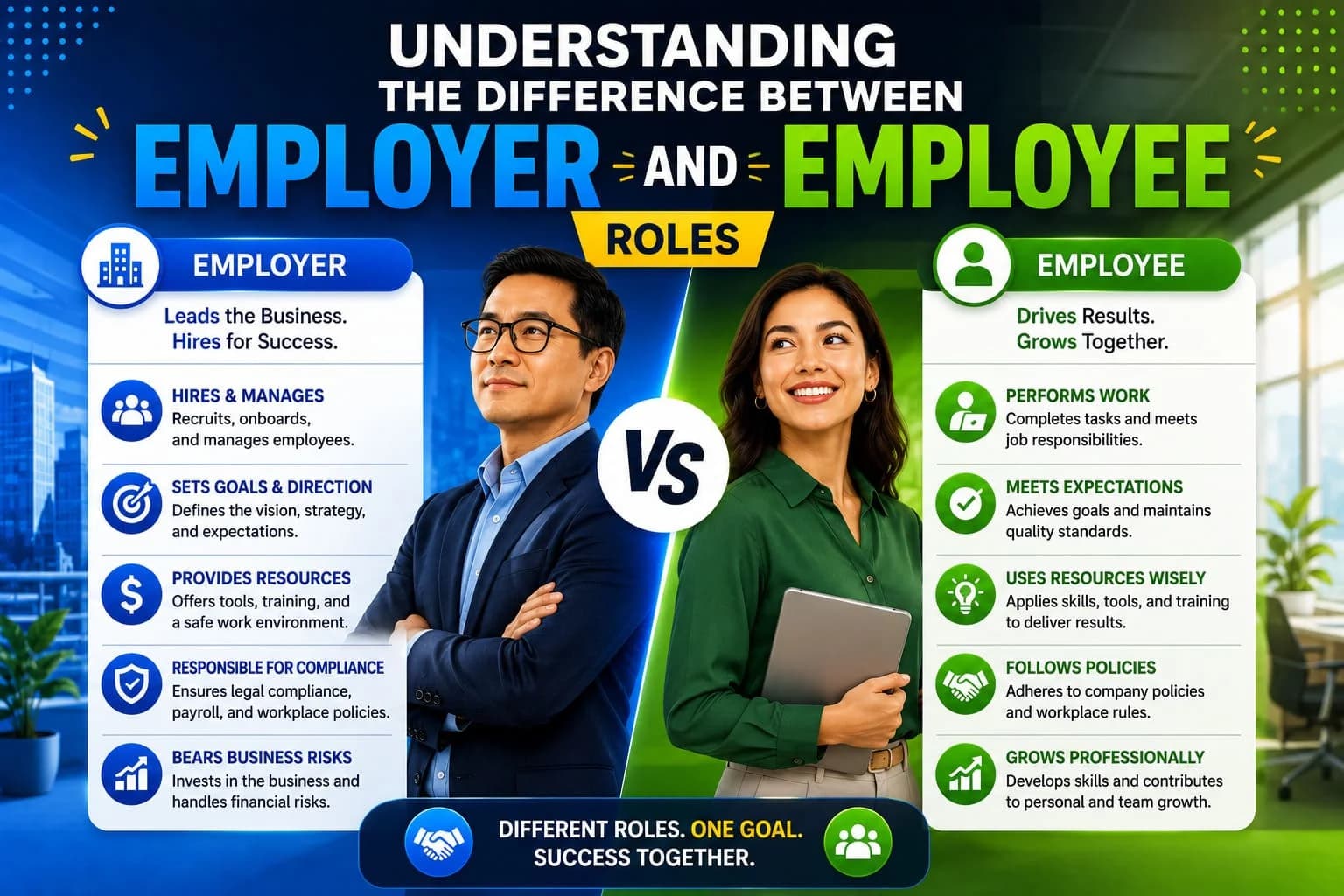
Employer vs. Employee: The Basic Difference
The easiest way to understand the distinction is to look at what each party does.
Employer | Employee |
|---|---|
Hires workers | Is hired to perform work |
Provides compensation | Receives compensation |
Defines roles and responsibilities | Performs assigned responsibilities |
Manages the employment relationship | Works within the employment relationship |
Handles applicable payroll obligations | Receives salary through payroll |
Pays applicable employer contributions | Pays applicable employee contributions |
Establishes workplace policies | Follows applicable workplace policies |
Manages employee performance | Performs according to agreed expectations |
The two sides have different responsibilities, but they are part of the same employment relationship.
What Are the Responsibilities of an Employer?
An employer's responsibilities go beyond simply paying a salary.
The exact obligations depend on the employee, company, and applicable Philippine laws, but they can include several important areas.
Paying employees correctly
Employers are responsible for paying employees according to the agreed compensation and applicable employment requirements.
Payroll may involve:
Basic salary
Applicable overtime
Holiday pay
Night-shift differential
Bonuses or commissions
Allowances
Payroll deductions
13th-month pay
The Department of Labor and Employment publishes information and labor advisories concerning Philippine employment standards.
Handling SSS contributions
Covered private-sector employers have responsibilities under the Philippine Social Security System.
These can include employer registration, reporting employees, deducting the employee's contribution, paying the employer's contribution, and remitting the required amounts.
Official employer and contribution information is available from the Social Security System.
Handling PhilHealth
Employers may also have responsibilities involving employee registration, deductions, employer contributions, and remittances to PhilHealth.
Official information is available through PhilHealth.
Handling Pag-IBIG
Pag-IBIG Fund is another part of employment administration for covered workers.
Employers may have responsibilities involving registration, employee deductions, employer contributions, and remittances.
Employers and employees can check current information through the Pag-IBIG Fund.
Maintaining employment records
Employers should maintain accurate records covering matters such as:
Employment contracts
Salary
Attendance
Payroll
Leave
Government contributions
Changes in employment
Employee information
Good recordkeeping protects both sides when questions or disputes arise.
Providing a safe workplace
Employers also have responsibilities involving occupational safety and health.
Workplace safety requirements depend on the nature of the business and the work being performed.
Information about Philippine occupational safety and health programs can be found through the Occupational Safety and Health Center.
What Are the Responsibilities of an Employee?
Employees also have responsibilities within the employment relationship.
These normally begin with performing the job they were hired to do.
Performing assigned work
Employees are expected to perform the duties associated with their position.
A customer service representative, for example, might be expected to respond to customers, document cases, and follow company procedures.
A software developer might be expected to build software, fix defects, review code, and document technical work.
The exact responsibilities should be made clear through the employment agreement, job description, company policies, and instructions from management.
Following reasonable workplace policies
Employees are generally expected to follow applicable company policies and procedures.
These can cover:
Attendance
Working hours
Security
Confidentiality
Data protection
Workplace conduct
Equipment use
Communication
Leave requests
Employees should receive clear information about the policies that apply to them.
Providing accurate information
Employees may also need to provide accurate personal and employment information for payroll and government records.
This can include information connected to SSS, PhilHealth, Pag-IBIG, tax records, and banking.
Communicating changes
Employees should inform their employer when relevant information changes.
This might include:
Address
Bank details
Contact information
Government membership information
Other information required for employment administration
Employer vs. Employee SSS Contributions
SSS provides a useful example of how employer and employee responsibilities differ.
Under the current regular Social Security contribution structure, contributions are shared between employer and employee.
The employer handles payroll administration, withholds the employee's applicable contribution, adds the employer's contribution, and remits the required amount.
The employee's share is therefore different from the employer's share.
Employees should also monitor their contribution history to make sure contributions are appearing correctly.
Current contribution schedules and other information are available from the Social Security System.
Employer vs. Employee in a Simple Payroll Example
Suppose Maria earns a monthly salary of ₱40,000.
Maria's responsibilities include performing the work she was hired to do and complying with applicable workplace policies.
Her employer's responsibilities can include:
Employer:
Pays Maria's salary
↓
Calculates payroll
↓
Withholds applicable employee deductions
↓
Adds applicable employer contributions
↓
Remits required contributions
↓
Provides payroll records
Maria receives her net salary after applicable deductions.
The employer's total cost of employing Maria can therefore be higher than her ₱40,000 monthly salary.
That cost may also include employer SSS, PhilHealth, Pag-IBIG, benefits, 13th-month pay, and other applicable employment costs.
Employer vs. Supervisor: They Are Not the Same
A common mistake is assuming that your manager is your employer.
Consider this example:
Employer: ABC Technologies Philippines, Inc.
Employee: Maria Santos
Supervisor: David Cruz
David manages Maria's work.
But ABC Technologies Philippines, Inc. employs Maria.
If an official form asks Maria for her employer name, she would normally enter the company's name, not David's.
Your supervisor represents the company in managing your work, but the legal employer may be the company itself.
Employer vs. Company Owner
The company owner is also not automatically the employer in an individual capacity.
Suppose Pedro Reyes owns:
Reyes Business Solutions, Inc.
The company hires 20 employees.
In formal employment documents, the employer may be Reyes Business Solutions, Inc., rather than Pedro Reyes personally.
The company and its owner can be legally distinct.
This is another reason employees should check their employment contracts when they need the exact name of their employer.
Employer vs. Client
The distinction between an employer and a client has become more important with remote work.
Suppose a Filipino graphic designer provides services to a US company as an independent contractor.
The US company may be the designer's client, not necessarily their employer.
Compare that with a Filipino graphic designer who is formally employed by a Philippine company and assigned to support a US client.
The structure might look like:
US client
↓
Philippine employer
↓
Employee
The employee works with the US client but is employed by the Philippine company.
The company receiving someone's work is therefore not automatically that person's legal employer.
Employee vs. Independent Contractor
An employee and an independent contractor are also not necessarily the same.
An employee works within an employment relationship.
An independent contractor generally provides services under a commercial or service arrangement.
The distinction matters because employment can come with statutory rights, protections, and employer obligations that may not apply in the same way to an independent contractor.
Companies should not assume that simply calling someone a "freelancer" or "contractor" settles the question.
The actual working relationship matters.
If classification is uncertain, businesses should seek appropriate Philippine legal or professional advice rather than relying only on the title used in a contract.
What If You Work for a Foreign Company?
Remote work can make the employer-employee distinction less obvious.
Suppose Maria lives in Manila but works every day with a US technology company.
There are several ways the relationship could be structured.
Direct employment through a Philippine entity
The US company may own a Philippine subsidiary.
The structure could be:
US Technology Company
↓
US Technology Philippines, Inc.
↓
Maria
Maria works for the international business, but the Philippine entity may be her legal employer.
Independent contractor
Maria could have a service agreement directly with the US company.
In that case, she may be an independent contractor rather than an employee.
Employer of Record
The US company could also hire Maria through an Employer of Record in the Philippines.
In that arrangement, another company becomes Maria's legal employer.
Employer and Employee Roles Under an Employer of Record
An Employer of Record, or EOR, creates an interesting distinction between legal employment and day-to-day management.
Consider this structure:
US Company
↓
Philippine EOR
↓
Employee
The EOR is the employee's legal employer.
The US company generally manages the employee's actual work.
For example, the US company may decide:
What projects the employee works on
Who the employee reports to
What targets need to be achieved
What tools the employee uses
How the team works together
The EOR may handle:
Employment contract
Payroll
SSS
PhilHealth
Pag-IBIG
Applicable tax withholding
Employment administration
This is why an employee working through an EOR may have two company names associated with their job.
The company they work with every day and the company that legally employs them may be different.
What About BPO Employees?
The same distinction can appear in the Philippine BPO industry.
Suppose Juan works in customer support for a US online retailer.
Every day, Juan:
Answers the retailer's customers
Uses the retailer's systems
Learns the retailer's products
Follows the client's customer-service procedures
But Juan was hired by:
Manila Customer Solutions, Inc.
His structure might therefore be:
US retailer, client
↓
Manila Customer Solutions, Inc., employer
↓
Juan, employee
Juan may casually tell someone he supports the US retailer.
But his legal employer may still be the Philippine BPO company.
Why the Employer-Employee Difference Matters
The distinction is not just about terminology.
It can determine who is responsible for important parts of employment.
These can include:
Salary
Payroll
SSS contributions
PhilHealth contributions
Pag-IBIG contributions
Employment contracts
Leave
Workplace policies
Employment records
Applicable benefits
Termination procedures
It can also matter when an employee applies for:
A loan
A visa
A new job
A rental property
A background check
Employment verification
Knowing exactly who employs you can prevent confusion when different company names appear across your records.
How to Identify Your Employer
If you are not sure who your employer is, start with your official records.
Check your employment contract
Look for the company or individual identified as the employer.
Check your payslip
See which organization appears on your payroll documentation.
Check your certificate of employment
The organization issuing the certificate may identify your legal employer.
Check government records
Relevant records with SSS, PhilHealth, and Pag-IBIG may also help identify the employer associated with your employment.
Ask HR
If several company names appear in your records, ask HR:
"What is the full legal name of my employer?"
This is particularly useful for workers employed through BPO companies, staffing agencies, subsidiaries, or Employers of Record.
Common Misunderstandings
"My manager is my employer."
Not necessarily.
Your manager supervises your work. Your employer may be the company that hired you.
"The company I support is my employer."
Not always.
If you work for a BPO, staffing company, or EOR, the client you support may be different from your legal employer.
"Anyone who gets paid for work is an employee."
Not necessarily.
Independent contractors and freelancers also receive payment for work but may have a different legal relationship with their clients.
"The employer pays all statutory contributions."
Not necessarily.
Some Philippine statutory contributions involve both employer and employee shares.
"A foreign company cannot have Philippine employees."
A foreign business may use different structures to build a Philippine workforce, including a local entity or an Employer of Record, depending on its circumstances.
Employer vs. Employee at a Glance
Question | Employer | Employee |
|---|---|---|
Who provides the job? | Employer | |
Who performs the work? | Employee | |
Who pays compensation? | Employer | |
Who receives compensation? | Employee | |
Who manages payroll? | Employer | |
Who follows workplace duties? | Employee | |
Who pays the employer share of applicable contributions? | Employer | |
Who pays the employee share of applicable contributions? | Employee | |
Who manages the employment relationship? | Employer | Participates in it |
The exact rights and responsibilities depend on the employment arrangement and applicable law.
Frequently Asked Questions
What is the main difference between an employer and an employee?
An employer hires workers and provides compensation for their work.
An employee performs work for the employer in exchange for compensation.
Who is considered an employer?
An employer can be a company, organization, or individual that employs workers.
For employees of incorporated businesses, the employer may be the legal company rather than its owner, CEO, or manager personally.
Who is considered an employee?
An employee is a person working under an employment relationship in exchange for compensation.
Is my manager my employer?
Usually not.
Your manager or supervisor directs your work, while your employer is generally the company or organization that employs you.
Is a freelancer an employee?
Not automatically.
A freelancer may be an independent contractor rather than an employee. The actual nature of the working relationship matters.
Who pays SSS, the employer or employee?
For covered employment, regular SSS contributions include an employer share and an employee share.
The employer handles the payroll deduction and remittance process.
Current contribution information is available from the Social Security System.
Who pays PhilHealth?
PhilHealth contributions generally involve employer and employee responsibilities for covered private-sector employment.
Employers and employees should check the latest requirements through PhilHealth.
Who pays Pag-IBIG?
Covered employment can involve contributions from both the employer and employee.
Current membership and contribution information is available from the Pag-IBIG Fund.
Who is my employer if I work through an EOR?
The Employer of Record is generally the legal employer.
The client company typically manages your daily work.
Check your employment contract for the exact legal employer.
Who is my employer if I work for a BPO?
The BPO company that hired you may be your employer even if you spend your working day supporting another company's account.
Check your employment contract and certificate of employment.
Employer and Employee: The Simple Definition
The difference between an employer and an employee comes down to their roles in the employment relationship.
The employer hires, compensates, and manages the employment relationship.
The employee performs work in exchange for compensation.
In a simple employment arrangement, identifying each side is easy.
The distinction becomes more important when several organizations are involved.
A worker might support a foreign company but be employed by a Philippine BPO. Another worker might work for an overseas startup but be legally employed through an Employer of Record. A freelancer might perform similar work but remain an independent contractor.
When there is uncertainty, look beyond the company logo or the name of the manager assigning the work.
Check the employment contract, payroll records, certificate of employment, and applicable government records.
For Philippine employment standards and worker rights, employers and employees can consult the Department of Labor and Employment. Information about statutory programs is also available directly from the Social Security System, PhilHealth, and Pag-IBIG Fund.
The basic distinction remains simple: the employer provides the employment, while the employee performs the work.
You might also like
More guides on Employer of Records.
Navigating Employer of Record Payroll Services: A Comprehensive Guide
Explore the benefits of Employer of Record payroll services and how they can streamline your global hiring process.
How an Employer of Record in the Philippines Transformed Hiring
Discover how a U.S. company leveraged an Employer of Record in the Philippines to streamline hiring and payroll, boosting efficiency and reducing costs.
EOR vs PEO: Weighing the Pros and Cons for US Employers
Discover the pros and cons of EOR vs PEO for US employers. Understand key differences and make informed decisions for your business.
PEO vs ASO: Weighing Pros and Cons for Employers
Deciding between a PEO and an ASO? Explore the pros and cons to make the best choice for your business.
Latest Virtual Assistant Jobs
Fresh remote VA roles — apply directly