
How to Use EOR Services in the Philippines: A Step-by-Step Guide
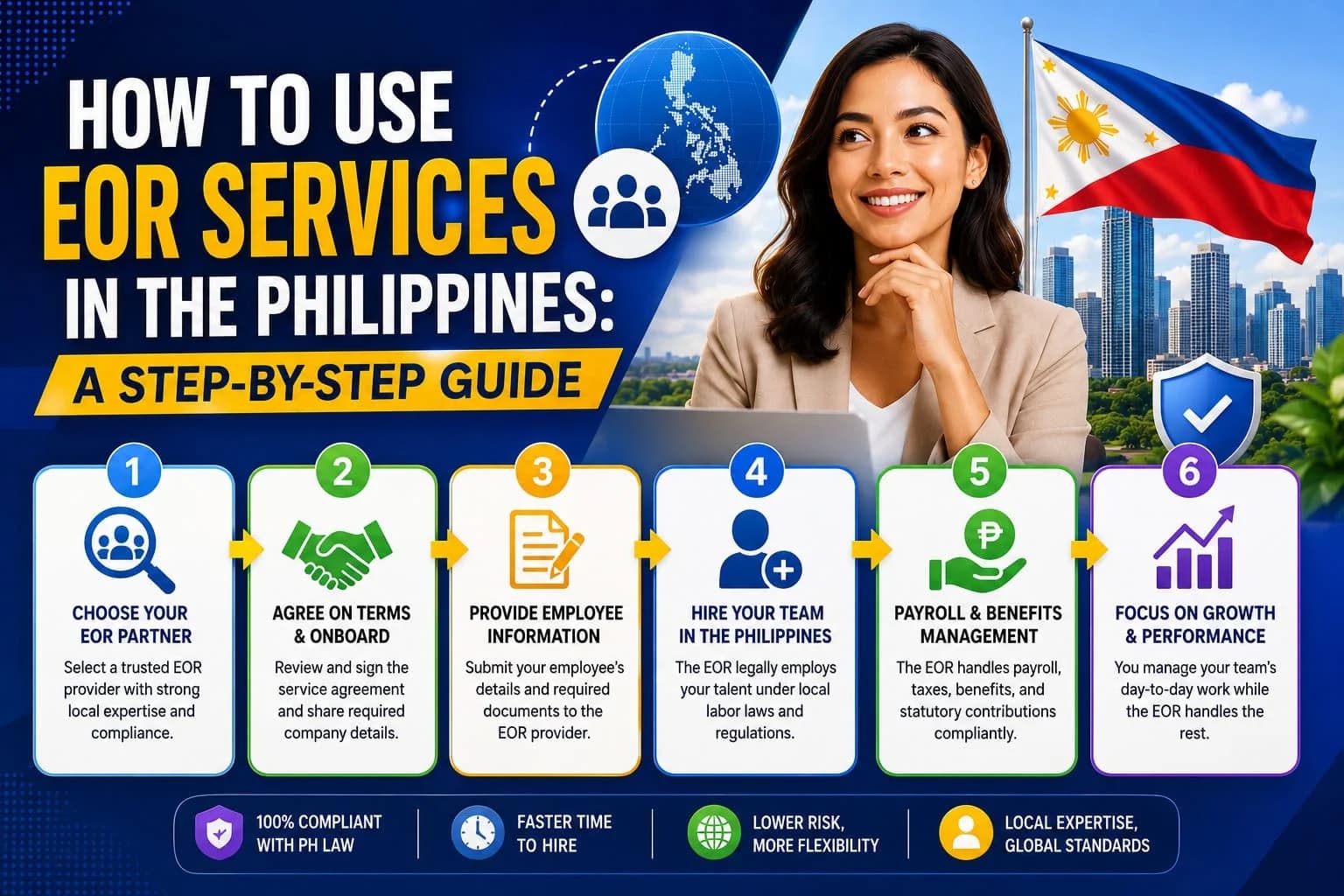
Quick Answer
Discover the step-by-step process of utilizing Employer of Record services in the Philippines. Learn the differences between employers, PEO vs ASO, and benefits of EOR.
Table of Contents
- 1.Step 1: Determine Whether an EOR Is the Right Structure
- 2.Step 2: Understand Who Employs the Worker
- 3.Step 3: Define the Role Before Requesting Quotes
- 4.Step 4: Request a Fully Loaded Employment Cost
- 5.Step 5: Understand Philippine SSS Contributions
- 6.Step 6: Confirm PhilHealth Administration
- 7.Step 7: Confirm Pag-IBIG Administration
- 8.Step 8: Account for 13th-Month Pay
- 9.Step 9: Compare EOR Providers
- 10.Step 10: Review the EOR Services Agreement
- 11.Step 11: Review the Philippine Employment Contract
- 12.Step 12: Onboard the Employee
- 13.Step 13: Establish the Payroll Workflow
- 14.Step 14: Check the First Payslip
- 15.Step 15: Plan for Philippine Holidays
- 16.Step 16: Establish a Leave-Approval Process
- 17.Step 17: Continue Managing the Employee's Performance
- 18.Step 18: Handle Termination Through the EOR
- 19.Step 19: Monitor EOR Performance
- 20.Step 20: Reassess the EOR Model as Your Team Grows
- 21.EOR vs. PEO: Which One Do You Need?
- 22.EOR vs. Independent Contractors
- 23.Philippine EOR Checklist
- 24.Frequently Asked Questions
- 25.Final Steps: From Candidate to Philippine Employee
How to Use EOR Services in the Philippines: A Step-by-Step Guide
Hiring employees in the Philippines can give international companies access to a large English-speaking workforce without requiring them to immediately establish their own Philippine legal entity.
The challenge is employment administration.
Once a foreign company wants to hire a Philippine worker as an employee, it must account for employment contracts, payroll, taxes, Social Security System contributions, PhilHealth, Pag-IBIG, 13th-month pay, holidays, leave, and other local employment requirements.
An Employer of Record (EOR) in the Philippines provides one way to manage these responsibilities.
The EOR becomes the worker's legal employer in the Philippines, while the client company continues to direct the employee's day-to-day work.
Here is how to use EOR services in the Philippines step by step.
Step 1: Determine Whether an EOR Is the Right Structure
Start by deciding whether you actually need an Employer of Record.
An EOR is particularly useful when:
Your business is based outside the Philippines.
You do not have a Philippine legal entity.
You want to hire Philippine employees rather than independent contractors.
You are hiring your first few employees in the country.
You want someone else to manage local payroll and employment administration.
You want to test the Philippine market before creating a permanent local entity.
For example, suppose a US company wants to hire three employees in the Philippines.
One option is to establish a Philippine company and create its own payroll and HR infrastructure.
Another option is to use an EOR.
The structure becomes:
Foreign company → Philippine EOR → Philippine employee
The EOR manages the formal employment relationship. The client company manages the employee's actual work.
Step 2: Understand Who Employs the Worker
This is one of the most important parts of the EOR model.
Under an EOR arrangement:
The EOR is the legal employer.
The EOR generally handles the formal employment administration, including payroll and applicable statutory obligations.
The client company manages the employee's work.
The client usually determines:
Job responsibilities
Projects
Performance expectations
Reporting structure
Work tools
Daily communication
Business objectives
Before signing with an EOR, ask the provider:
Which Philippine legal entity will actually appear as the employee's employer?
Some global EOR providers employ workers through their own local entities, while others may use local partners.
You should understand the structure before hiring.
Step 3: Define the Role Before Requesting Quotes
Do not contact an EOR with only a job title.
Prepare enough information for the provider to calculate a realistic employment cost.
Include:
Job title
Job description
Monthly basic salary
Expected start date
Work location
Working hours
Shift schedule
Benefits
Allowances
Bonuses or commissions
Equipment requirements
Leave policy
Reporting manager
This makes it easier for the EOR to identify the relevant employment and payroll requirements.
It also allows you to compare providers based on the same employee profile.
Step 4: Request a Fully Loaded Employment Cost
Do not compare EOR providers based solely on statements such as:
“Our EOR fee is $499 per month.”
That is only the provider fee.
Ask instead:
“What will this employee cost us in total?”
A useful quotation should separate:
Cost | Monthly or Annual Amount |
|---|---|
Basic salary | ₱X |
Employer SSS | ₱X |
Employer PhilHealth | ₱X |
Employer Pag-IBIG | ₱X |
13th-month pay accrual | ₱X |
Benefits | ₱X |
EOR service fee | ₱X |
Other fees | ₱X |
Total employment cost | ₱X |
Also ask about:
Setup fees
Security deposits
Foreign-exchange fees
Bank-transfer charges
Benefit costs
Off-cycle payroll
Expense-processing fees
Contract-change fees
Termination charges
Offboarding fees
This will give you a much more useful comparison than the advertised EOR fee alone.
Step 5: Understand Philippine SSS Contributions
An EOR employing workers in the Philippines should administer applicable Social Security System contributions.
As of the current SSS schedule, Social Security contributions are 15% of the applicable Monthly Salary Credit, divided between the employer and employee.
The employer pays 10%, while the employee pays 5%.
The current maximum Monthly Salary Credit for contribution purposes is ₱35,000.
This means that at the maximum contribution base, the employer's Social Security share can reach:
₱35,000 × 10% = ₱3,500 per month
Employers also pay the Employees' Compensation contribution.
For workers with a Monthly Salary Credit of ₱15,000 or more, the current employer-paid EC contribution is ₱30 per month.
A Philippine EOR should calculate, report, and remit the applicable amounts as part of payroll administration.
Official contribution information is available from the Philippine Social Security System.
Step 6: Confirm PhilHealth Administration
PhilHealth is another important part of Philippine employment administration.
Your EOR should explain:
How the employee is registered
How the contribution is calculated
What portion is paid by the employee
What portion is funded by the employer
When contributions are remitted
How contribution records are made available to the employee
Do not simply assume that “statutory contributions included” means every filing and remittance is handled.
Ask the provider to confirm this in writing.
Official information is available from PhilHealth.
Step 7: Confirm Pag-IBIG Administration
Covered employees may also have Pag-IBIG Fund contribution obligations.
The EOR should administer the applicable employer and employee contributions and remittances.
Ask whether the provider handles:
Employee registration
Employer counterpart contributions
Monthly deductions
Remittance
Contribution records
Changes in employee status
Official information is available from the Pag-IBIG Fund.
Step 8: Account for 13th-Month Pay
This is one of the most important differences for companies unfamiliar with Philippine employment.
Eligible rank-and-file private-sector employees are entitled to 13th-month pay.
DOLE's current guidance states that the minimum payment is generally:
Total basic salary earned during the calendar year ÷ 12
and applies to covered employees who have worked for at least one month during the calendar year.
For example, if an employee earns:
₱50,000 per month
for a complete year:
₱50,000 × 12 = ₱600,000 annual basic salary
The corresponding full-year 13th-month amount would generally be:
₱600,000 ÷ 12 = ₱50,000
This means salary plus 13th-month pay alone becomes:
₱650,000
before statutory employer contributions, benefits, or EOR fees.
Ask the EOR whether it accrues the expected 13th-month obligation monthly or bills it separately later in the year.
Step 9: Compare EOR Providers
Once you understand the expected costs, create a shortlist of Philippine EOR providers.
Compare them across the same criteria.
Legal Structure
Ask:
Do you have your own Philippine legal entity?
Which company will appear on the employee's contract?
Do you use a third-party local partner?
Payroll
Ask:
When is payroll processed?
What is the payroll cut-off?
When are salaries received?
Can you handle bonuses?
Can you handle commissions?
Can you process expenses?
Can you run off-cycle payroll?
Compliance
Ask whether the provider administers:
SSS
PhilHealth
Pag-IBIG
13th-month pay
Philippine holidays
Leave requirements
Employment documentation
Support
Ask:
Does the employee receive local HR support?
How quickly are payroll problems resolved?
Who handles employee questions?
Is support available in Philippine business hours?
Pricing
Ask for:
Monthly EOR fee
Deposit
Setup fee
FX charges
Benefits costs
Termination charges
Offboarding fees
Other administrative charges
Do not select a provider purely because its monthly EOR fee is the lowest.
Step 10: Review the EOR Services Agreement
After choosing a provider, review the agreement between your company and the EOR.
Pay particular attention to:
Provider responsibilities
Client responsibilities
Payroll funding
Payment deadlines
EOR fees
Deposits
Currency conversion
Benefits
Confidentiality
Data protection
Liability
Employee changes
Termination procedures
Contract cancellation
Employee transfer
Offboarding
You should understand what happens not only when you hire an employee, but also when you want to change salary, promote them, put them on a performance plan, or end employment.
Step 11: Review the Philippine Employment Contract
The EOR will normally enter into the local employment agreement with the worker.
Review the contract before the employee signs it.
Check:
Correct legal employer
Employee name
Job title
Salary
Start date
Work location
Working hours
Benefits
Probationary terms
Leave
Confidentiality
Applicable policies
Termination provisions
Your commercial agreement with the EOR and the employment agreement with the employee should not contradict each other.
For unusual or higher-risk employment arrangements, Philippine legal advice may be appropriate.
Step 12: Onboard the Employee
Once the contracts are signed, the EOR can begin the local employment onboarding process.
The employee may need to provide information such as:
Identification
Tax information
SSS details
PhilHealth details
Pag-IBIG details
Address
Bank information
Emergency contacts
Other employment documents
The EOR should then register the worker in its payroll and employment systems.
However, the client company still needs to manage operational onboarding.
That can include:
Laptop or equipment
Company email
Software accounts
Team introductions
Training
Internal documentation
Security access
Communication tools
Performance expectations
Legal onboarding and operational onboarding are two separate processes.
Step 13: Establish the Payroll Workflow
Before the first payroll cycle, agree on exactly how information moves between your company and the EOR.
For example:
Client company submits payroll changes
↓
EOR verifies payroll inputs
↓
EOR issues funding request
↓
Client funds payroll
↓
EOR processes deductions and contributions
↓
Employee receives salary and payslip
↓
EOR handles applicable statutory remittances
Determine which information you must submit before each payroll.
This may include:
Base salary
Attendance
Overtime
Night-shift hours
Holiday work
Bonuses
Commissions
Expenses
Leave
Unpaid absences
Missed payroll cut-offs can delay adjustments or require off-cycle processing.
Step 14: Check the First Payslip
Review the employee's first payroll carefully.
Verify:
Basic salary
Gross pay
SSS deduction
PhilHealth deduction
Pag-IBIG deduction
Tax withholding
Other deductions
Reimbursements
Net salary
Payroll period
Payment date
Also compare the EOR's invoice against the quotation.
Check:
Employer contributions
Benefits
EOR fee
Currency conversion
Additional charges
The first payroll is often the best opportunity to identify discrepancies before they become recurring errors.
Step 15: Plan for Philippine Holidays
Philippine holidays can affect employee scheduling and payroll.
DOLE issues labor advisories specifying wage rules for regular holidays and special days. Its 2026 advisories include specific wage-payment guidance for holidays such as Independence Day, Eid'l Adha, Eid'l Fitr, Maundy Thursday, Good Friday, Araw ng Kagitingan, and other designated days.
Ask the EOR to provide a holiday calendar and explain:
Which dates are regular holidays
Which are special non-working days
Whether your employee is expected to work
What pay treatment applies
When payroll inputs must be submitted
Do not automatically apply the client company's home-country holiday rules to Philippine employees.
Step 16: Establish a Leave-Approval Process
Define how leave requests are handled.
A simple process might be:
Employee submits leave request
↓
Client manager approves
↓
EOR records approved leave for payroll
Make sure the EOR and client company have matching records.
Clarify how the provider administers:
Vacation leave
Sick leave
Unpaid leave
Statutory leave
Maternity-related leave
Other applicable leave
Also distinguish between benefits required by law and additional company benefits.
Step 17: Continue Managing the Employee's Performance
Using an EOR does not mean outsourcing management.
The client company should still manage:
Goals
Performance
Training
Feedback
Role development
Team relationships
Promotions
Business priorities
The EOR handles the employment infrastructure.
The client company manages the person as part of the team.
However, consult the EOR before making material changes to the employment relationship, including:
Salary reduction
Working-hour changes
Major role changes
Disciplinary action
Formal performance processes
Termination
These changes may have local employment-law implications.
Step 18: Handle Termination Through the EOR
Do not terminate a Philippine EOR employee informally.
If you want to end employment:
Contact the EOR.
Explain the reason.
Provide supporting documentation.
Ask the EOR to identify the required procedure.
Determine applicable notice, process, and final-pay requirements.
Allow the EOR to administer the formal termination.
Philippine employment rules distinguish between different grounds and procedures for termination.
For complex or disputed cases, appropriate Philippine employment counsel may also be necessary.
Step 19: Monitor EOR Performance
Review the provider periodically.
Track:
Payroll accuracy
Payroll timeliness
Employee support
Response times
Invoice accuracy
Contribution administration
Benefits administration
FX charges
Unexpected fees
Employee complaints
Contract changes
A provider that looked inexpensive during procurement can become costly if payroll problems or hidden charges occur repeatedly.
Step 20: Reassess the EOR Model as Your Team Grows
An EOR does not have to remain your permanent employment structure.
It can serve as a bridge.
For example:
1–5 employees
Use an EOR to enter the Philippine market quickly.
5–20 employees
Continue using the EOR while validating the operation.
Larger permanent team
Compare continuing EOR fees with the cost of establishing your own Philippine entity.
There is no universal headcount at which a local entity becomes cheaper.
The correct point depends on:
EOR fees
Employee count
Payroll size
Benefits
Accounting costs
Legal costs
Internal HR capacity
Local management
Long-term business plans
Model the two scenarios rather than relying on a fixed rule.
EOR vs. PEO: Which One Do You Need?
EOR and PEO services are related but structurally different.
Feature | EOR | PEO |
|---|---|---|
Legal employer | EOR | Client remains an employer under co-employment |
Local employing entity needed by client | Usually no | Generally yes |
Payroll | Yes | Yes |
HR administration | Yes | Yes |
International hiring without own entity | Major use case | Generally not the primary use |
Best suited for | Entering a country without an entity | Outsourcing HR for an existing workforce |
If your company does not have a Philippine entity and wants a provider to legally employ Philippine workers, an EOR is generally the relevant model.
EOR vs. Independent Contractors
Another option is hiring Philippine professionals as independent contractors.
Contracting can be appropriate when the working relationship is genuinely independent.
It should not simply be chosen because it avoids employee payroll costs.
The actual working relationship matters when determining worker classification.
If your company wants someone to operate as a long-term employee integrated into the organization, an EOR offers a formal employment route without requiring your company to immediately establish its own Philippine entity.
If worker classification is uncertain, obtain appropriate professional advice.
Philippine EOR Checklist
Before hiring your first employee, confirm:
We understand why we are using an EOR.
We know which Philippine company will legally employ the worker.
We have defined the job and compensation.
We have received a fully loaded cost estimate.
SSS administration is included.
PhilHealth administration is included.
Pag-IBIG administration is included.
13th-month pay is accounted for.
We understand benefits costs.
We understand EOR fees.
We understand the FX rate and any conversion fees.
We know the payroll cut-off.
We know when the employee will be paid.
We have reviewed the employment contract.
We understand holiday treatment.
We have a leave process.
We understand offboarding and termination procedures.
We know what additional fees may apply.
We have a process for checking invoices and payroll.
We will periodically review whether an EOR still makes economic sense.
Frequently Asked Questions
What is an Employer of Record in the Philippines?
An Employer of Record legally employs workers in the Philippines on behalf of another company.
The EOR manages the formal employment administration while the client company generally manages the employee's actual work.
Can a foreign company hire Philippine employees without opening a Philippine company?
An EOR can provide an employment structure through which a foreign company hires Philippine employees without first establishing its own Philippine employing entity, subject to the provider's structure and applicable requirements.
Who pays the Philippine employee?
The EOR normally processes payroll and pays the employee.
The client company funds the salary, employer costs, benefits, EOR fees, and other agreed charges.
Does an EOR handle SSS?
A Philippine EOR would generally be expected to administer applicable SSS contributions for employees it legally employs.
Current SSS contribution information is available directly from SSS.
Does an EOR handle PhilHealth and Pag-IBIG?
These are important parts of Philippine employment administration.
Confirm that the provider handles applicable registration, calculation, deductions, employer contributions, remittance, and reporting.
Does an EOR handle 13th-month pay?
A Philippine EOR should account for applicable 13th-month pay requirements for covered employees.
DOLE states that the minimum is generally one-twelfth of the employee's total basic salary earned during the year.
Is an EOR the same as a PEO?
No.
An EOR becomes the legal employer of workers hired through the arrangement.
A PEO generally operates through a co-employment relationship with a company that already employs its workers.
Is an EOR better than using contractors?
Neither structure is automatically better.
Contracting may be appropriate for genuinely independent service providers.
An EOR may be more appropriate when the company wants the worker to be formally employed without establishing a Philippine entity.
How much does a Philippine EOR cost?
Costs vary between providers.
The total cost normally includes more than the monthly EOR fee:
Salary + statutory employer costs + 13th-month pay + benefits + EOR fee + other applicable charges
Always ask for a fully loaded employment-cost estimate.
Final Steps: From Candidate to Philippine Employee
Using an EOR in the Philippines is easiest when the process is approached systematically.
The practical sequence is:
1. Decide whether an EOR fits your hiring structure.
2. Define the employee, salary, benefits, and working arrangement.
3. Calculate the fully loaded cost of employment.
4. Compare several Philippine EOR providers.
5. Verify which entity will legally employ the worker.
6. Review pricing, payroll, SSS, PhilHealth, Pag-IBIG, and 13th-month pay.
7. Review the EOR agreement.
8. Review the Philippine employment contract.
9. Complete legal and operational onboarding.
10. Establish payroll cut-offs and funding procedures.
11. Verify the first payroll and payslip.
12. Manage holidays and leave correctly.
13. Continue managing employee performance internally.
14. Coordinate material employment changes with the EOR.
15. Follow the proper procedure when employment ends.
16. Reassess the EOR arrangement as your Philippine workforce grows.
For companies making their first hires in the Philippines, an EOR can remove much of the need to build local employment infrastructure from scratch.
The key is to treat the EOR as more than a payroll provider.
Understand who legally employs the worker, exactly what the provider handles, what the employee costs in total, and how the relationship will work throughout the entire employment lifecycle.
Official Philippine Resources
Employers should verify current requirements directly with the relevant government agencies:
Social Security System: SSS contributions and employer requirements
PhilHealth: national health insurance and employer requirements
Pag-IBIG Fund: membership and employer contributions
Department of Labor and Employment: labor standards, holiday advisories, 13th-month pay, and employment guidance
Contribution schedules, labor advisories, wage rules, and employment requirements can change. Confirm current requirements with the relevant agency, your EOR provider, or qualified Philippine employment counsel before making employment decisions.
You might also like
More guides on Employer of Records.
Navigating Employer of Record Payroll Services: A Comprehensive Guide
Explore the benefits of Employer of Record payroll services and how they can streamline your global hiring process.
How an Employer of Record in the Philippines Transformed Hiring
Discover how a U.S. company leveraged an Employer of Record in the Philippines to streamline hiring and payroll, boosting efficiency and reducing costs.
EOR vs PEO: Weighing the Pros and Cons for US Employers
Discover the pros and cons of EOR vs PEO for US employers. Understand key differences and make informed decisions for your business.
PEO vs ASO: Weighing Pros and Cons for Employers
Deciding between a PEO and an ASO? Explore the pros and cons to make the best choice for your business.
Latest Virtual Assistant Jobs
Fresh remote VA roles — apply directly