
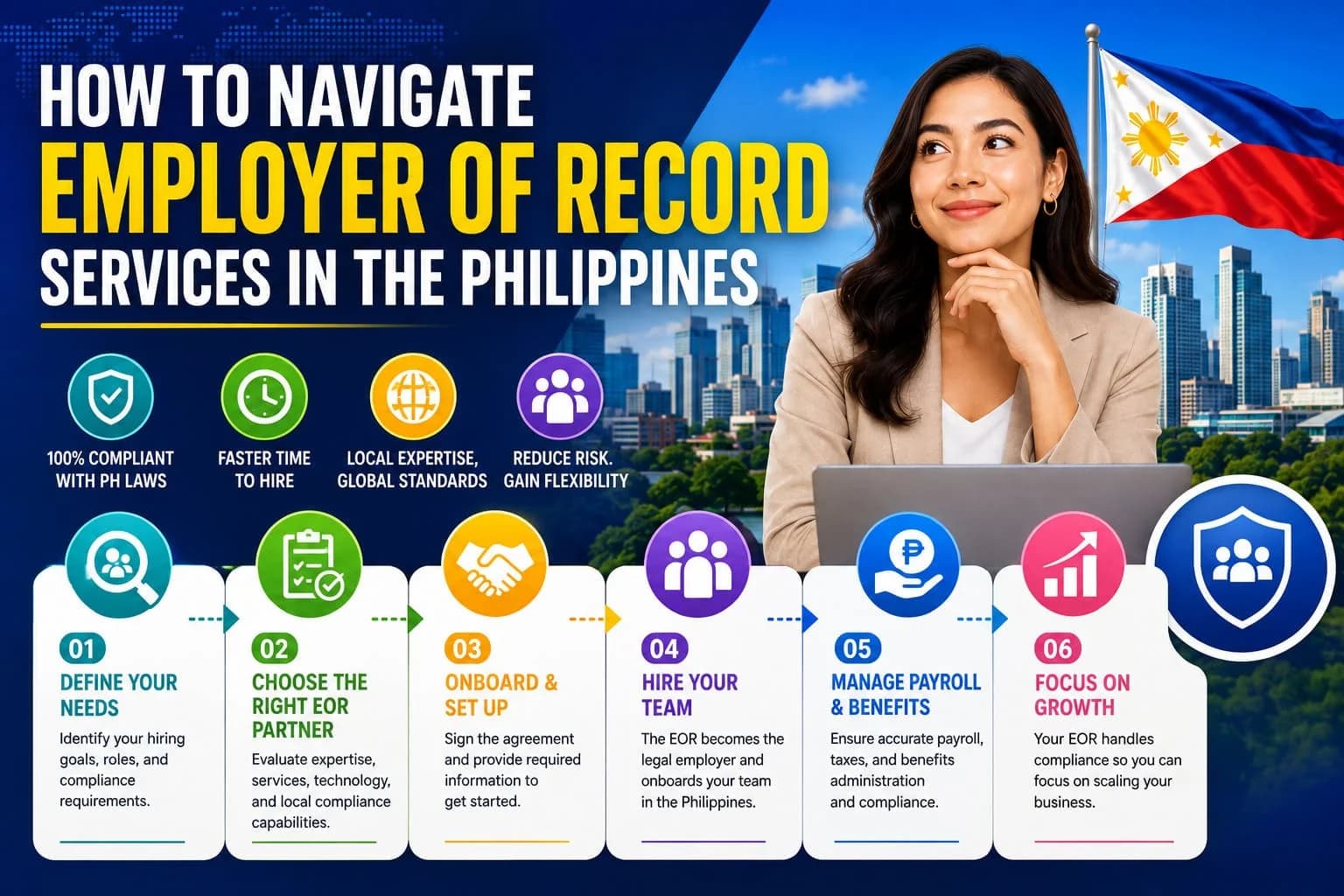
How to Navigate Employer of Record Services in the Philippines
Quick Answer
Learn step-by-step how to utilize Employer of Record services in the Philippines for efficient payroll management and compliance.
Table of Contents
- 1.Step 1: Decide Whether You Need an EOR
- 2.Step 2: Understand Who the Legal Employer Is
- 3.Step 3: Define the Position You Want to Hire
- 4.Step 4: Ask for the Total Employment Cost
- 5.Step 5: Check How SSS Will Be Handled
- 6.Step 6: Confirm PhilHealth Administration
- 7.Step 7: Confirm Pag-IBIG Administration
- 8.Step 8: Budget for 13th-Month Pay
- 9.Step 9: Shortlist EOR Providers
- 10.Step 10: Understand EOR vs. PEO vs. ASO
- 11.Step 11: Review the EOR Agreement Carefully
- 12.Step 12: Review the Employee's Employment Contract
- 13.Step 13: Onboard the Employee
- 14.Step 14: Set Up the Payroll Process
- 15.Step 15: Check the First Payroll
- 16.Step 16: Plan for Philippine Holidays
- 17.Step 17: Set a Clear Leave Process
- 18.Step 18: Continue Managing the Employee
- 19.Step 19: Handle Termination Through the EOR
- 20.Step 20: Review Whether the EOR Still Makes Sense
- 21.The Benefits That Actually Matter
- 22.Frequently Asked Questions
- 23.How to Navigate EOR Services Successfully
How to Navigate Employer of Record Services in the Philippines
Hiring in the Philippines can be straightforward until a foreign company reaches one important question: Who will legally employ the worker?
A company based in the United States, Europe, Australia, or elsewhere may find the right candidate in the Philippines but have no Philippine company, payroll system, or local employment infrastructure.
An Employer of Record, or EOR, offers one way to solve that problem.
The EOR becomes the worker's legal employer in the Philippines. The foreign company continues to manage the employee's work, while the EOR handles local employment administration such as contracts, payroll, statutory contributions, and other compliance requirements.
The arrangement can be useful for companies making their first hires in the Philippines, testing a Philippine team, or expanding before deciding whether to establish their own local entity.
Here is how to navigate the process.
Step 1: Decide Whether You Need an EOR
Start with your employment structure.
An EOR may make sense if:
Your company is based outside the Philippines.
You do not have a Philippine entity that can employ workers.
You want to hire employees rather than independent contractors.
You are making your first few hires in the country.
You want local payroll and employment administration handled for you.
You are testing the Philippines before making a larger investment.
Consider a US software company that wants to hire two developers in Manila.
It could establish a Philippine company, register with the relevant government agencies, set up payroll, arrange accounting, and build local HR processes.
Or it could hire through an EOR.
The structure would look like this:
Foreign company
↓
Philippine Employer of Record
↓
Philippine employee
The foreign company manages the employee's work.
The EOR handles the formal employment relationship.
Step 2: Understand Who the Legal Employer Is
This distinction is important.
Under a typical EOR arrangement, the EOR is the legal employer.
The client company still decides what the employee does.
For example, the client company may control:
Job responsibilities
Projects
Performance expectations
Reporting lines
Work tools
Team communication
Business targets
The EOR may handle:
Employment contracts
Payroll
SSS
PhilHealth
Pag-IBIG
Tax withholding
Payslips
Leave administration
Employment records
Onboarding
Offboarding
Before choosing an EOR, ask one very simple question:
Which Philippine legal entity will appear as the employee's employer?
Do not assume the answer based only on the EOR provider's brand.
Some international providers use their own Philippine entities. Others may work through local partners.
Know which entity will actually employ your worker.
Step 3: Define the Position You Want to Hire
Before requesting an EOR quotation, prepare the details of the job.
At minimum, define:
Job title
Job description
Monthly salary
Expected start date
Work location
Working hours
Shift schedule
Benefits
Allowances
Bonuses or commissions
Equipment requirements
Reporting manager
This matters because employment cost is not based on the EOR fee alone.
The employee's salary, working arrangement, and benefits can affect the final cost.
A provider can give you a much more useful quote if you say:
We want to hire a customer support specialist in Manila at ₱45,000 per month, working a US night shift.
rather than:
How much does your EOR cost?
Step 4: Ask for the Total Employment Cost
One of the easiest mistakes to make is comparing EOR providers only by their advertised monthly fee.
An EOR might advertise:
$399 per employee per month
But that is not what the employee costs the business.
The actual cost can include:
Cost | Amount |
|---|---|
Basic salary | ₱X |
Employer SSS | ₱X |
Employer PhilHealth | ₱X |
Employer Pag-IBIG | ₱X |
13th-month pay accrual | ₱X |
Benefits | ₱X |
EOR fee | ₱X |
Other charges | ₱X |
Total employment cost | ₱X |
Ask each provider for a fully loaded example.
Also ask whether there are separate charges for:
Setup
Security deposits
Currency conversion
International transfers
Benefits
Insurance
Expense processing
Off-cycle payroll
Contract changes
Employee termination
Offboarding
The provider with the lowest headline price may not have the lowest final cost.
Step 5: Check How SSS Will Be Handled
SSS is one of the main statutory programs an EOR should be able to explain clearly.
Under the current SSS contribution structure, regular Social Security contributions are 15% of the applicable Monthly Salary Credit.
The employer contributes 10%, while the employee contributes 5%.
The maximum Monthly Salary Credit is currently ₱35,000.
Employers also fund the applicable Employees' Compensation contribution.
For current contribution tables and payment rules, use the official Social Security System guidance. SSS contribution information
When evaluating an EOR, ask:
Who registers the employee?
Who calculates the contribution?
Who deducts the employee share?
Who pays the employer share?
Who remits the contribution?
Can the employee see proof that contributions were posted?
A good provider should be able to answer these questions without ambiguity.
Step 6: Confirm PhilHealth Administration
PhilHealth is separate from SSS.
Employers have obligations involving employee premiums, employer counterpart shares, remittance, and reporting.
PhilHealth states that employers must correctly and timely remit employee premium contributions, including the employer counterpart, and report those payments so contributions can be properly posted.
You can review employer requirements directly through PhilHealth. PhilHealth employer information
Ask the EOR to confirm that it handles:
Registration
Payroll calculation
Employee deductions
Employer contribution
Remittance
Reporting
Contribution records
Do not settle for a vague statement that "government contributions are included."
Ask what is actually being done.
Step 7: Confirm Pag-IBIG Administration
Pag-IBIG Fund is another part of formal Philippine employment.
Your EOR should explain how it handles applicable Pag-IBIG registration, employee deductions, employer counterpart contributions, and remittance.
Official information is available through the Pag-IBIG Fund. Pag-IBIG Fund
Again, the important point is accountability.
You should know who calculates the contribution, who remits it, and how both the company and employee can confirm that payments were made.
Step 8: Budget for 13th-Month Pay
Foreign employers unfamiliar with Philippine payroll can easily overlook 13th-month pay.
DOLE's current guidance states that covered rank-and-file private-sector employees who have worked for at least one month during the calendar year are entitled to 13th-month pay.
The minimum amount is generally calculated as:
Total basic salary earned during the calendar year ÷ 12
DOLE also states that the required amount must be paid no later than December 24.
For example, an employee earning ₱50,000 per month for a full year would have:
Annual basic salary:
₱50,000 × 12 = ₱600,000
13th-month pay:
₱600,000 ÷ 12 = ₱50,000
Salary plus 13th-month pay alone becomes:
₱650,000
before employer statutory contributions, benefits, and EOR fees.
Current labor advisories can be checked directly through DOLE. DOLE labor advisories
Ask the EOR whether 13th-month pay is accrued monthly or charged separately later in the year.
That affects cash-flow planning.
Step 9: Shortlist EOR Providers
Once you understand the employment costs, compare providers.
Do not compare only websites and pricing pages.
Evaluate each provider across five areas.
Legal structure
Ask:
Do you own the Philippine entity?
What is the entity's legal name?
Do you use a third-party partner?
Who signs the employment contract?
Payroll
Ask:
What is the payroll cut-off?
When will employees receive salary?
Can you process bonuses?
Can you process commissions?
Can you reimburse expenses?
Can you run off-cycle payroll?
Philippine compliance
Confirm that the provider handles applicable:
SSS
PhilHealth
Pag-IBIG
Tax withholding
13th-month pay
Holiday payroll
Leave
Employment documentation
Employee support
Ask:
Who does the employee contact when payroll is wrong?
Is support located in the Philippines?
What are support hours?
What happens if an employee has a government contribution problem?
Pricing
Request the complete fee structure.
Ask about:
Monthly fee
Deposit
FX markup
Setup fees
Benefits
Payroll fees
Termination fees
Offboarding fees
Step 10: Understand EOR vs. PEO vs. ASO
These terms are often grouped together, but they do not describe the same structure.
Model | Basic Structure |
|---|---|
EOR | Provider legally employs the worker |
PEO | Provider generally operates through co-employment |
ASO | Provider performs HR administration without co-employment |
An EOR is usually the relevant option when the central problem is:
"We want to hire someone in the Philippines but do not have a Philippine employing entity."
A PEO generally assumes that the client already has the legal structure needed to employ the workforce and wants HR support through a co-employment arrangement.
An ASO provides administrative HR services while the client remains the employer.
This distinction matters because payroll outsourcing alone does not solve the absence of a local employing entity.
Step 11: Review the EOR Agreement Carefully
Once you select a provider, you will normally enter into a commercial agreement with the EOR.
Read it carefully.
Pay attention to:
Services included
EOR fees
Payment terms
Payroll funding
Deposits
FX rates
Benefits
Data handling
Confidentiality
Responsibility for government contributions
Employment changes
Liability
Termination
Offboarding
Contract cancellation
One section deserves particular attention:
What happens when the employee leaves?
It is easy to focus entirely on onboarding when choosing an EOR.
Offboarding can be more complicated.
Understand the process and potential costs before signing.
Step 12: Review the Employee's Employment Contract
The EOR will generally sign the local employment agreement with the employee.
Your company should still review it.
Check:
Legal employer
Employee name
Job title
Salary
Start date
Work location
Working hours
Benefits
Probationary terms
Leave
Confidentiality
Applicable company policies
Termination provisions
Make sure the employment agreement reflects what was actually offered to the candidate.
If you promised ₱60,000 per month, a specific allowance, or a particular benefit during recruitment, those details should not disappear when the EOR prepares the contract.
Step 13: Onboard the Employee
Once the agreements are signed, the EOR handles the formal employment onboarding.
The employee may need to provide:
Identification
Tax information
SSS details
PhilHealth details
Pag-IBIG details
Bank account information
Address
Emergency contact
Other required employment documents
The client company handles the operational side.
That can include:
Laptop
Company email
Software access
Training
Team introductions
Security access
Documentation
Work processes
The EOR employs the worker.
It does not replace your responsibility for making the employee productive and part of the team.
Step 14: Set Up the Payroll Process
Before the first payroll, map the process.
A typical workflow might look like this:
Client submits payroll information
↓
EOR calculates payroll
↓
EOR sends funding request
↓
Client funds payroll
↓
EOR processes salary and deductions
↓
Employee receives salary
↓
EOR remits applicable statutory contributions
Find out what information you need to send each payroll period.
That can include:
Salary changes
Attendance
Overtime
Holiday work
Night-shift hours
Bonuses
Commissions
Expenses
Leave
Unpaid absences
Also confirm the cut-off.
Submitting information after the payroll deadline may mean waiting until the next payroll or paying for an off-cycle run.
Step 15: Check the First Payroll
Do not assume the first payroll is correct.
Review it.
Check the employee's:
Basic salary
Gross pay
SSS
PhilHealth
Pag-IBIG
Tax
Other deductions
Expenses
Net pay
Payment date
Then check your company's invoice.
Look at:
Employer contributions
Benefits
EOR fee
Exchange rate
Additional charges
Ask the employee whether the salary arrived on time and whether the payslip makes sense.
Small mistakes in the first month can become recurring problems if nobody notices them.
Step 16: Plan for Philippine Holidays
Philippine holidays can affect payroll differently depending on the type of holiday and whether the employee works.
DOLE regularly publishes wage-payment advisories for regular holidays and special days. In 2026, it has continued issuing advisories specifying how wages should be handled for individual holidays and special non-working days.
Employers should therefore avoid applying their home-country holiday rules automatically to Philippine employees.
Ask your EOR for:
Annual Philippine holiday calendar
Holiday classifications
Applicable payroll treatment
Submission deadlines for holiday work
Rules for employees who work those days
Current advisories are available through DOLE. Current DOLE labor advisories
Step 17: Set a Clear Leave Process
Decide how leave requests will move between the employee, your managers, and the EOR.
For example:
Employee requests leave
↓
Client manager approves
↓
EOR records approved leave
The important thing is that the client's records and EOR's payroll records match.
Clarify how the provider manages:
Vacation
Sick leave
Unpaid leave
Statutory leave
Maternity-related leave
Other applicable leave
You should also know which leave benefits come from Philippine law and which are additional benefits provided by your company.
Step 18: Continue Managing the Employee
The EOR is not the employee's day-to-day manager.
Your company still needs to manage:
Performance
Goals
Feedback
Training
Promotions
Responsibilities
Team communication
Career development
However, involve the EOR before making changes that affect the formal employment relationship.
Examples include:
Salary changes
Working-hour changes
Major changes in responsibilities
Formal disciplinary action
Performance processes
Termination
A decision that seems operational to the client company may have employment-law consequences in the Philippines.
Step 19: Handle Termination Through the EOR
Do not terminate an EOR employee informally.
Do not simply send a Slack message or email saying that employment ends immediately.
If the employment relationship needs to end:
Contact the EOR.
Explain the situation.
Provide relevant documentation.
Ask which process applies.
Determine notice and final-pay requirements.
Have the EOR administer the formal employment process.
For complicated situations, Philippine employment counsel may also be appropriate.
DOLE provides official information and labor resources for employers and workers. Department of Labor and Employment
Step 20: Review Whether the EOR Still Makes Sense
An EOR can be a good way to make the first few hires in a country.
It does not have to remain the permanent structure.
Consider reviewing the arrangement each year.
Ask:
How many Philippine employees do we have?
What are we paying in EOR fees?
Are payroll and contributions being handled correctly?
Are employees satisfied with support?
Are there recurring hidden fees?
Are FX costs reasonable?
Do we expect the team to keep growing?
Would establishing our own Philippine entity now make sense?
A company might use an EOR for three employees and find it extremely convenient.
At 30 or 50 employees, the economics may look different.
There is no universal number at which establishing an entity becomes cheaper.
The company needs to compare the actual cost of:
EOR fees
against:
Incorporation + accounting + payroll + HR + compliance + entity maintenance + internal administration
The Benefits That Actually Matter
EOR services are often marketed with long lists of benefits.
In practice, four matter most.
You can hire before establishing an entity
This is the central reason many international companies use an EOR.
You can begin building a Philippine team before making the larger commitment of establishing your own company.
Local payroll administration is already in place
You do not need to build Philippine payroll processes from scratch for your first employee.
You can test the market
A business can hire a small team, see whether the Philippine operation works, and decide later whether to expand.
You can focus on the employee instead of payroll administration
Your managers can concentrate on recruiting, onboarding, training, and managing the worker while the EOR handles the local employment infrastructure.
That does not eliminate every employment risk or administrative responsibility.
It changes who manages much of the infrastructure.
Frequently Asked Questions
What is an Employer of Record in the Philippines?
An EOR is an organization that legally employs workers in the Philippines on behalf of another company.
The client company manages the employee's work while the EOR manages the formal employment relationship.
Can a foreign company hire Philippine employees without setting up a Philippine company?
An EOR can provide a structure that allows a foreign company to hire Philippine employees without first establishing its own local employing entity, subject to the provider's structure and applicable requirements.
Who is the employee's legal employer?
Under an EOR arrangement, the EOR is generally the legal employer.
Check the employment agreement to identify the exact company.
Does an EOR handle SSS?
A Philippine EOR should be able to administer applicable SSS requirements for the employees it legally employs.
Current contribution requirements are available directly from SSS. SSS contribution information
Does an EOR handle PhilHealth?
A Philippine EOR would generally be expected to handle applicable PhilHealth payroll administration for covered employees.
PhilHealth maintains official employer guidance. PhilHealth employer guidance
Does an EOR handle Pag-IBIG?
The provider should confirm whether it handles applicable Pag-IBIG registration, deductions, employer contributions, remittance, and records.
Official information is available from Pag-IBIG. Pag-IBIG Fund
Does an EOR handle 13th-month pay?
A Philippine EOR should account for applicable 13th-month pay requirements for covered employees.
DOLE states that covered rank-and-file employees who have worked for at least one month during the year are entitled to the benefit and that the minimum amount is generally one-twelfth of the basic salary earned during the calendar year.
How much does a Philippine EOR cost?
Pricing varies by provider.
Do not compare only the EOR management fee.
Calculate:
Salary + statutory employer costs + 13th-month pay + benefits + EOR fee + other provider charges
That is a more useful measure of the actual cost.
Is an EOR the same as a PEO?
No.
An EOR becomes the legal employer of workers hired through the arrangement.
A PEO generally works through a co-employment structure.
Is an EOR the same as payroll outsourcing?
No.
A payroll provider processes payroll for employees your company already employs.
An EOR also provides the legal employment structure.
Can I move employees from an EOR to my own Philippine company later?
Potentially, yes.
Companies sometimes use an EOR when first entering a country and later move workers to their own entity.
The transfer should be planned carefully with the EOR and appropriate professional advisers because it involves changing the employee's legal employment arrangement.
How to Navigate EOR Services Successfully
The hardest part of using an Employer of Record is not finding a provider.
It is understanding exactly what you are buying.
Before signing an agreement, make sure you know:
Who employs the worker
What the employee costs in total
Who handles SSS, PhilHealth, and Pag-IBIG
How payroll is funded
How 13th-month pay is handled
What the EOR charges beyond its monthly fee
What happens when employment terms change
What happens when the employee leaves
The process should look something like this:
1. Decide whether an EOR is the right employment model.
2. Define the employee and compensation.
3. Request a fully loaded cost estimate.
4. Compare several Philippine EOR providers.
5. Verify the legal employing entity.
6. Check SSS, PhilHealth, Pag-IBIG, payroll, and 13th-month administration.
7. Review the commercial EOR agreement.
8. Review the employee's local employment contract.
9. Complete onboarding.
10. Establish payroll and funding procedures.
11. Check the first payroll.
12. Manage holidays and leave correctly.
13. Continue managing employee performance yourself.
14. Coordinate formal employment changes with the EOR.
15. Handle termination through the proper process.
16. Reassess the arrangement as your Philippine team grows.
For current employment standards, employers can consult the Department of Labor and Employment. Department of Labor and Employment
For statutory contribution information, use the official websites of the Social Security System, PhilHealth, and Pag-IBIG rather than relying only on an EOR provider's sales material.
An EOR can make hiring in the Philippines much easier. The key is knowing where the EOR's responsibilities end and where yours begin.
You might also like
More guides on Employer of Records.
Navigating Employer of Record Payroll Services: A Comprehensive Guide
Explore the benefits of Employer of Record payroll services and how they can streamline your global hiring process.
How an Employer of Record in the Philippines Transformed Hiring
Discover how a U.S. company leveraged an Employer of Record in the Philippines to streamline hiring and payroll, boosting efficiency and reducing costs.
EOR vs PEO: Weighing the Pros and Cons for US Employers
Discover the pros and cons of EOR vs PEO for US employers. Understand key differences and make informed decisions for your business.
PEO vs ASO: Weighing Pros and Cons for Employers
Deciding between a PEO and an ASO? Explore the pros and cons to make the best choice for your business.
Latest Virtual Assistant Jobs
Fresh remote VA roles — apply directly