
Best Social Campaigns: 3 Models That Drive Business Results Today
Quick Answer
Learn how the best social campaigns use creator partnerships, UGC, and paid conversion campaigns to turn attention into qualified leads, sales, and growth.
Table of Contents
The best social campaigns do not win because they rack up the largest view count. They win because they move a specific business metric: qualified leads, purchases, email subscribers, demo requests, or even better applicants. A campaign can look busy on TikTok or Instagram and still produce nothing useful. That is why the first decision is not which platform to post on, which creator to hire, or how much to boost a post. It is choosing the campaign model that matches the outcome you need.
Most people get this wrong by starting with a trend. Start with the action instead. If you need trust, borrow it from a credible creator. If you need customers to show real enthusiasm, invite participation. If you need a predictable pipeline this quarter, build a paid conversion campaign with tracking in place before the first dollar is spent.
Here is the practical rule. Use creator partnership campaigns to borrow trust from people your buyers already listen to. Use UGC participation campaigns to earn reach and create reusable customer content. Use paid conversion campaigns to drive measurable actions such as purchases, lead forms, booked calls, and retargeting audiences. Internet access alone is not a competitive advantage in the United States, where 94.69% of the population used the internet in 2024, according to the World Bank. Relevance, offer quality, creative execution, and follow-up are what separate a useful campaign from noise.
| Campaign model | Best business outcome | Best-fit platforms | Main advantage | Main risk |
|---|---|---|---|---|
| Creator partnership campaign | Trust, product discovery, social proof | Instagram, TikTok, YouTube, LinkedIn for B2B | Uses an established audience and credible voice | Audience fit can be weak despite high follower counts |
| UGC participation campaign | Reach, community content, repeatable creative assets | TikTok, Instagram Reels, YouTube Shorts | Invites customers to make the campaign visible | Views can be disconnected from purchase intent |
| Paid conversion campaign | Leads, purchases, demos, retargeting | Meta, LinkedIn, TikTok, YouTube | Clear targeting and measurable next steps | Poor tracking can make spend look more effective than it is |
The best social media platform for marketing is not a universal ranking. It depends on how your audience behaves, what format makes the message believable, and the action you want them to take. A software buyer may watch a five-minute YouTube walkthrough before booking a demo. A skincare shopper may need a fast TikTok demonstration and customer comments. A local service prospect may convert after seeing a Meta ad, reading reviews, then submitting a form. Choose the model first, then choose the channel that supports that customer journey.
Source: World Bank Open Data
Step 1: Build Creator Partnership Campaigns That People Actually Trust
Creator partnerships work when a buyer needs proof before purchase. That is common with products that must be demonstrated, unfamiliar services, higher-priced offers, and B2B solutions where a respected practitioner can explain why something matters. The goal is not to rent a creator's follower count. It is to connect your product to a genuine customer problem in a voice people already trust.
Start by defining one problem. A meal-planning app might focus on “weekday dinners in 20 minutes,” not every feature in the product. Then shortlist creators by reviewing their comments, audience questions, prior brand work, and whether their usual content naturally fits your use case. A creator with 18,000 highly engaged followers in a specific niche can outperform someone with 500,000 broad, disengaged followers.
Agree on a real use case, clear disclosure requirements, and nonnegotiable factual claims. Give each creator a unique link, code, or landing page. If every partner uses the same link, you lose the ability to distinguish a strong fit from a weak one. In the US, GDP per capita reached $90,026.52 in 2025, according to the World Bank. In a high-spending market, a generic “save 15%” message is often a weak substitute for a crisp value proposition that explains why the offer is worth choosing.
- Pros: Credibility arrives faster when the recommendation fits the creator's established expertise.
- Pros: You receive efficient creative production from people who understand their audience and platform conventions.
- Pros: Niche creators can give small businesses access to focused communities that broad ads may miss.
- Cons: Creator quality varies widely, even among accounts with similar audience sizes.
- Cons: Brand-safety issues can arise if you do not review past content and establish boundaries.
- Cons: Attribution becomes weak when all partners point to one generic link or landing page.
Great social media campaigns protect the creator's natural voice. Give them the problem, the product facts, the required disclosure, and the desired call to action. Do not hand them a polished brand script that sounds unlike everything else they post. Good social media campaigns feel like useful advice or an honest demonstration, not an interruption wearing a creator's face.
Step 2: Create UGC Participation Campaigns With a Reason to Join
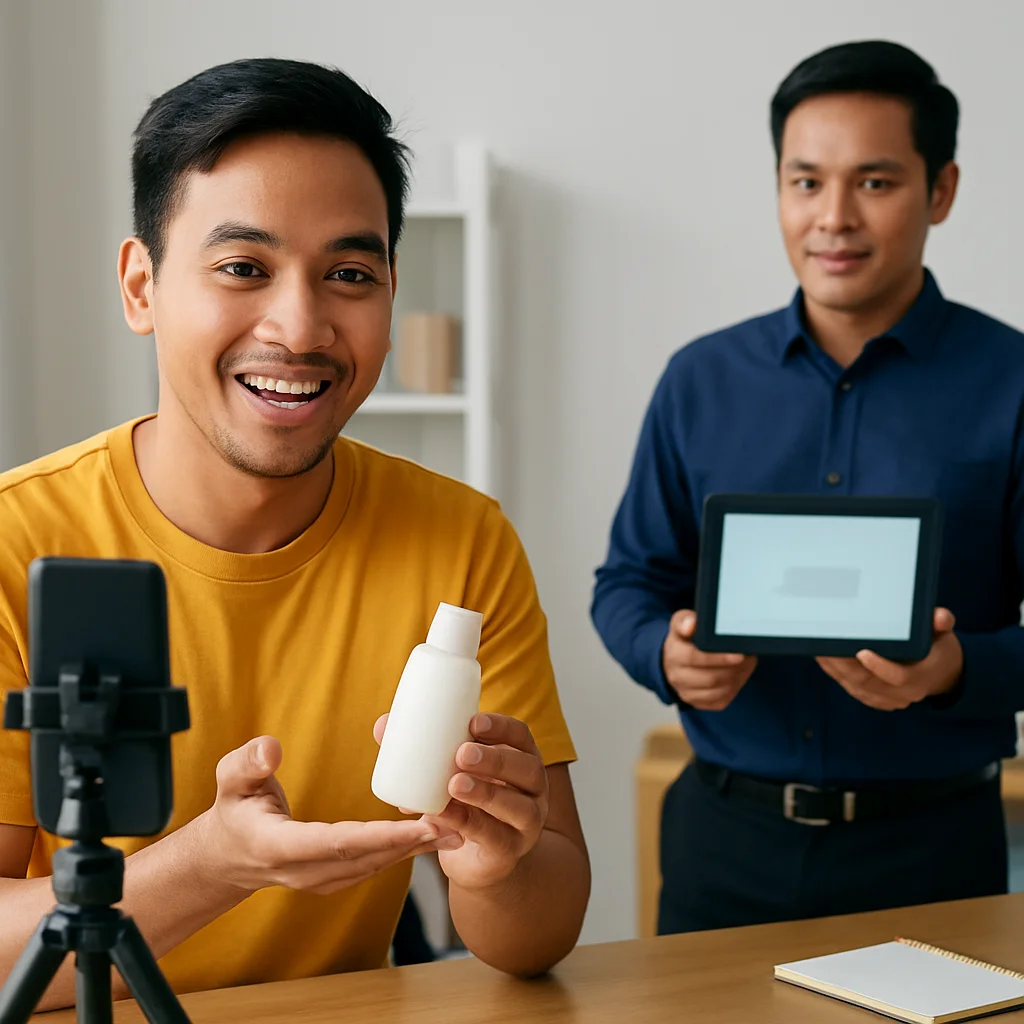
A user-generated content campaign asks customers or community members to make the campaign visible themselves. It can be powerful, but only if participation has a real point. “Share your story” is not a campaign concept. “Show your before-and-after workspace using our 10-minute reset,” paired with a featured post, useful prize, or community recognition, is much closer.
Build the campaign in a practical sequence. First, identify a customer behavior worth showing: a transformation, a routine, a reaction, a result, or a creative challenge. Make the prompt understandable in seconds. Provide one strong example video or post so people know what good participation looks like. Give them a reason to join beyond vague encouragement. Finally, obtain clear permission before using submissions in paid ads, on product pages, or in email campaigns.
- Pros: Authentic customer posts create social proof that is difficult for a brand to manufacture.
- Pros: Participation can build a library of customer-led creative for future organic and paid use.
- Pros: The right prompt has potential for organic distribution beyond your existing audience.
- Cons: Participation is unpredictable, especially when the task requires too much effort or vulnerability.
- Cons: You need moderation processes for off-brand, unsafe, or misleading submissions.
- Cons: Viral attention can bring in people who enjoy the trend but will never become customers.
Viral social media campaigns can be useful, but virality is a distribution event, not a business result. A million views from the wrong viewers may have less value than 300 visits from buyers who request a quote. Before declaring success, measure branded search, qualified traffic, saves, email capture, and sales or leads separately from views. If the campaign attracts attention but branded search and qualified sessions stay flat, the content may be entertaining without building demand.
This model fits consumer brands, events, communities, and visual services where people can credibly show a transformation, result, or routine. It is usually a poor first choice for a complicated B2B product with a long sales process, unless the participants are customers sharing specific, verifiable outcomes.

Step 3: Launch Paid Conversion Campaigns on the Right Social Platform
Paid conversion campaigns are the strongest starting point when you already have a defined offer and need measurable pipeline. They are not simply “boosted posts.” A conversion campaign is a system: audience, message, landing page, event tracking, follow-up, and a decision about what happens after a lead arrives.
Choose one conversion event first. It could be a completed purchase, qualified lead form, booked consultation, demo request, or email signup. Build landing-page analytics and CRM tracking before launch, not after a campaign produces leads you cannot identify. Match the platform to the buying context, create multiple message angles, and keep prospecting separate from retargeting. Review lead quality with sales or customer support, then move budget only after downstream results validate the apparent winner.
- Pros: Paid media offers scalable distribution and more control over who sees the message.
- Pros: Retargeting lets you re-engage people who watched, visited, started a form, or viewed a product.
- Pros: Clear campaign structure can produce stronger attribution than purely organic activity.
- Cons: Creative fatigue can rapidly reduce performance when the same ads run too long.
- Cons: Costs can rise when targeting is broad and the message is generic.
- Cons: Platform-reported conversions can be misleading if they receive credit for people who would have converted anyway.
For the best social media to promote business, map the platform to intent. Meta is strong for broad consumer demand, visual offers, and retargeting. LinkedIn suits high-consideration B2B offers where role, seniority, company type, and industry matter. TikTok works for native short-form discovery when the creative earns attention quickly. YouTube is useful for demonstrations, comparisons, and search-adjacent intent. The best social media to advertise on is the one that lets your actual buyers take the next logical step.
Use incrementality to avoid fooling yourself. Give campaigns separate tracking, compare performance against a credible baseline, and ask whether the ads created additional conversions rather than merely claiming ones that would have happened anyway. This matters in B2B. US professional and business services employed 22.547 million workers in September 2026, up 0.5% year over year, according to the U.S. Bureau of Labor Statistics. That scale supports precise role and industry targeting, not generic awareness ads aimed at anyone who happens to work in an office.
Best Social Campaigns: Which Is Right for Your Business?
Here is the opinionated answer. Begin with paid conversion campaigns if you have a working offer, a functional landing page, and a real need for measurable leads or revenue. Use creator partnerships when trust is the main bottleneck and buyers need someone credible to demonstrate the value. Use UGC participation only when customers have a compelling action, result, or story they genuinely want to share.
The best social media for business is not where your brand gets the most views. It is where buyers can realistically take the next step, whether that means watching a demonstration, submitting a form, adding a product to cart, or asking for a demo. Best social media marketing is disciplined enough to measure that next step and honest enough to stop funding activity that only looks popular.
Before committing budget, check six things:
- What exact outcome do we want?
- Who is the audience, and where do they actually pay attention?
- What proof do they need before purchasing?
- Can we produce enough useful creative to sustain the campaign?
- Is tracking ready from the ad or post through to revenue or lead quality?
- Can our team respond quickly when interested people act?
If you cannot answer those questions, do not buy more reach yet. Fix the campaign design first. Better measurement and a clearer customer action will outperform a larger view count almost every time.
Recommended for you
Latest Virtual Assistant Jobs
Fresh remote VA roles: apply directly