
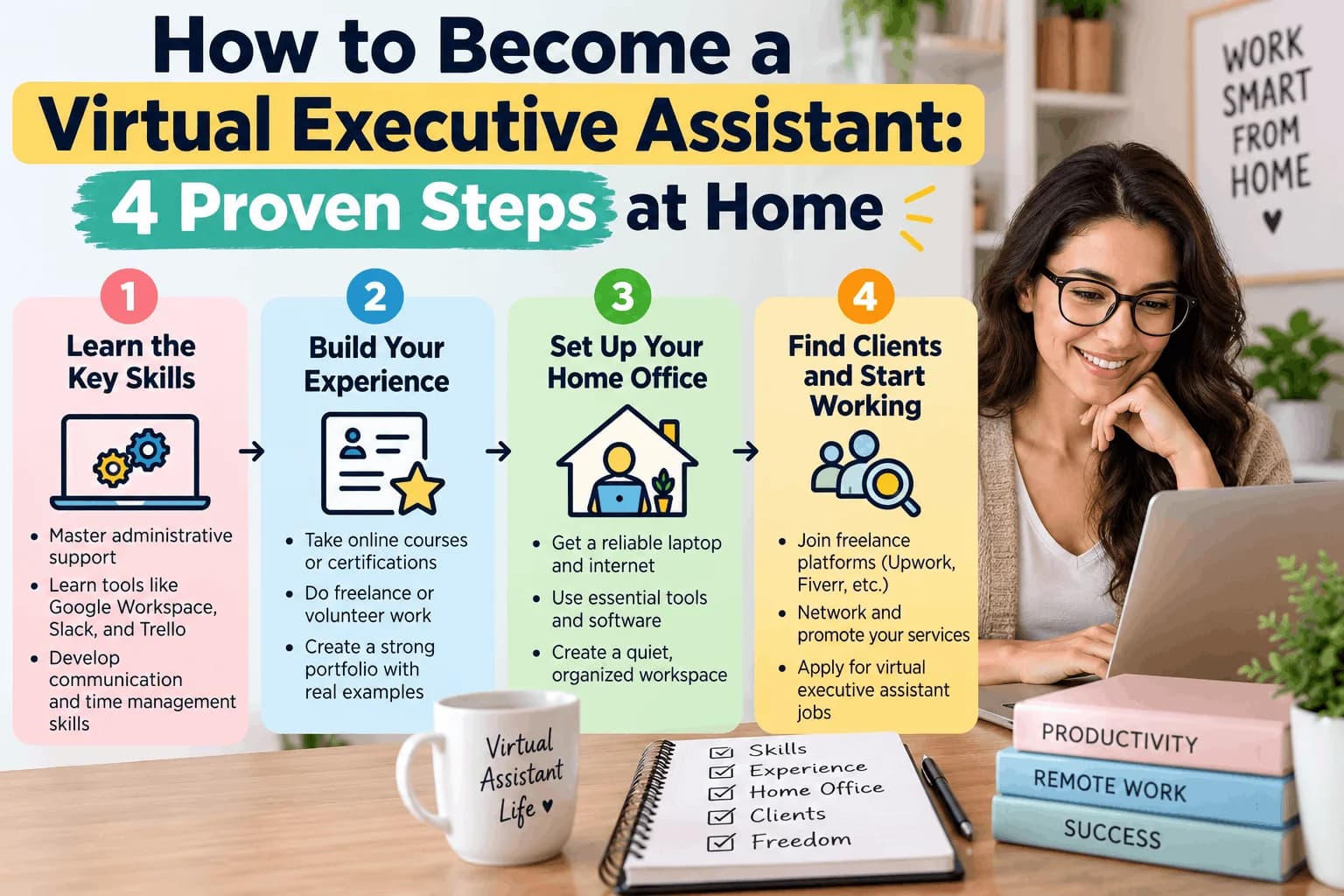
How to Become a Virtual Executive Assistant: 4 Proven Steps at Home
Quick Answer
Learn how to become a virtual executive assistant with executive-ready skills, portfolio proof, targeted job-search tactics, interview guidance, and a 30-day trust plan for remote work.
Table of Contents
- 1.Step 1: Build the Executive-Ready Skills Behind Remote Executive Assistant Work
- 2.Step 2: Set Up Your Tools, Portfolio, and Remote Work Systems
- 3.Step 3: Find Virtual Executive Assistant Jobs That Match Your Experience
- 4.Step 4: Apply, Interview, and Earn Trust in Your First 30 Days
- 5.Virtual Executive Assistant Job Market Data for U.S. Remote Work
- 6.The Executive Assistant Skill Most Portfolios Fail to Prove: Judgment Under Ambiguity
- 7.Frequently Asked Questions
Being able to book a meeting is not the same as being trusted to protect an executive’s time, priorities, and confidential information. A virtual executive assistant works remotely, but the standard is still executive-level: anticipating conflicts, filtering noise, and making sure important work does not disappear in a crowded inbox. That matters in a large professional economy. Professional and business services employed 22,635 thousand U.S. workers in August 2026, up 0.9% year over year, according to the U.S. Bureau of Labor Statistics. That figure does not measure VA roles specifically, but it does show the scale of the business environment where organized executive support matters.
To become a virtual executive assistant, build executive administration fundamentals, establish a dependable remote setup and tool stack, create proof through portfolio scenarios or past work, and target roles with tailored applications. This is remote executive support, not generic task completion: your value comes from making sound calls about priorities while keeping the executive informed.
Table of Contents
- Step 1: Build the Executive-Ready Skills Behind Remote Executive Assistant Work
- Step 2: Set Up Your Tools, Portfolio, and Remote Work Systems
- Step 3: Find Virtual Executive Assistant Jobs That Match Your Experience
- Step 4: Apply, Interview, and Earn Trust in Your First 30 Days
- Virtual Executive Assistant Job Market Data for U.S. Remote Work
Step 1: Build the Executive-Ready Skills Behind Remote Executive Assistant Work
A remote executive assistant manages work that is both practical and consequential. Typical responsibilities include triaging a calendar across time zones, preparing meeting briefs, handling travel changes, prioritizing inbox messages, processing expense workflows, updating a CRM, and following up on commitments without needing reminders. A strong assistant does not merely see a 9:00 a.m. meeting. They notice that it leaves no preparation time before a board call, then suggest a fix.
This is the difference between an administrative assistant who completes assigned tasks and an executive assistant who protects decision-maker time. The latter clarifies priorities, catches conflicts before they become problems, and knows when a small issue needs an immediate escalation. That is why many administrative assistant remote jobs can be a useful starting point, but executive support requires a more proactive mindset.
Build skills in a sensible order:
- Written communication: Write concise updates, clear subject lines, and action-oriented follow-ups. Executives should understand the point in seconds.
- Calendar management: Learn time-zone math, buffer time, recurring events, attendee context, and rescheduling etiquette.
- Documents and spreadsheets: Create meeting notes, trackers, simple reports, and clean presentation-ready files.
- Confidentiality: Treat compensation, customer issues, strategy, and personal schedules as protected information.
- Project tracking: Keep ownership, deadlines, blockers, and next steps visible.
- Business judgment: Understand what affects revenue, customers, deadlines, and executive attention.
For U.S.-facing remote executive assistant work, polished asynchronous communication is now basic competence. Internet use reached 94.69% of the U.S. population in 2024, according to the World Bank. In practice, that means employers expect smooth digital collaboration, reliable written updates, and prompt handoffs. Those are baseline expectations, not a special advantage.
{{IMAGE_1}}Step 2: Set Up Your Tools, Portfolio, and Remote Work Systems
Before applying, set up a work environment that makes you easy to trust. You do not need expensive gear, but you do need systems that reduce avoidable risk. Use a professional email address and LinkedIn profile. Have a reliable computer, backup internet plan, secure password manager, calendar platform, video meeting software, organized cloud storage, and task tracker. A quiet, well-lit meeting environment matters too. If your connection fails during a client call, a mobile hotspot and a practiced backup process are far more reassuring than an apology.
Your portfolio should prove that you can organize executive work, even if you have never held the exact title. Include sanitized samples such as:
- A weekly executive calendar that shows travel time, focus blocks, and time-zone labels.
- A meeting agenda and one-page brief with attendees, objectives, decisions needed, and follow-ups.
- A travel itinerary with flight details, hotel contacts, local transport, and contingency notes.
- An inbox-prioritization exercise explaining which messages need a reply, delegation, scheduling, or escalation.
- An SOP for recurring reporting, including deadlines, data sources, quality checks, and delivery steps.
Never expose a former employer’s private data to make a portfolio look real. Replace names, financial figures, email addresses, and company identifiers with fictional details. The goal is to demonstrate your thinking and organization, not reveal someone else’s information.
People moving from general virtual assistant work remote roles often undersell themselves by listing software only. Reframe the work around outcomes: “prevented recurring booking conflicts,” “reduced client response time,” or “created a tracker that made overdue approvals visible.” That language is much stronger than “proficient in Google Calendar.” For a broader foundation, read how to start virtual assistant work remote.
Step 3: Find Virtual Executive Assistant Jobs That Match Your Experience
Job searching gets easier when you define the role before you search. Decide which executive profiles you can support, such as founders, sales leaders, consultants, or operations executives. Then set your preferred industry, U.S. time-zone overlap, full-time or part-time availability, and employee or contractor preference. Search title variations including executive assistant, executive operations assistant, founder’s assistant, executive coordinator, and chief of staff assistant.
When reviewing jobs remote executive assistant listings, look beyond the title. Serious executive-support roles usually mention recurring executive-facing responsibilities, a reporting relationship, communication expectations, confidential material, and some decision-making context. Broad ads promising easy pay for vague online virtual assistant jobs are less useful because they often give you no way to prove a focused fit.
Use a repeatable process:
- Save listings where the responsibilities closely match your portfolio samples.
- Research the employer through its website, leadership profile, and official business channels.
- Tailor a small number of high-quality applications instead of sending fifty generic ones.
- Track application dates, contact names, follow-up dates, and interview stages.
- Reject any listing that asks for upfront fees, equipment payments, or sensitive data before legitimate hiring steps.
For candidates pursuing Philippines virtual assistant jobs with U.S. employers, state availability plainly. For example: “Available 9:00 a.m. to 1:00 p.m. Pacific Time, Monday through Friday.” Show the overlap rather than making a recruiter calculate it. Discuss payroll, contractor status, and local compliance only when the listing identifies the arrangement. The U.S. unemployment rate was 4.2% in 2025, per the World Bank. That is broad market context, not evidence of virtual executive assistant hiring volume, but it is a good reminder that specific proof matters in a competitive search.
For more tactics, see how to become a remote executive assistant and how to find virtual assistant jobs online.
{{IMAGE_2}}Step 4: Apply, Interview, and Earn Trust in Your First 30 Days
Every application should open with a tailored reason you fit the role. Follow that with two or three outcome-based proof points, a portfolio link, and clear availability. For example, mention that you coordinated meetings across multiple time zones, built a recurring status tracker, or handled sensitive customer records under a defined process. Generic claims such as “hardworking and detail-oriented” rarely carry weight because every applicant uses them.
In interviews, prepare short examples involving an urgent scheduling conflict, a vague executive request, confidential information, and competing deadlines. Be ready to explain your thought process, not just the final action. Suppose an executive is double-booked for an investor call and a customer escalation. A capable assistant identifies the investor call as difficult to move, checks whether another leader can handle the escalation, proposes revised options, confirms the executive’s choice, updates every participant, and closes the loop. The important part is not magically solving everything alone. It is bringing a clear recommendation quickly and documenting the decision.
Your first 30 days should focus on learning how the executive works. Build a priority map of key people, projects, recurring meetings, deadlines, and sensitive issues. Create a communication-preferences document: preferred channels, response expectations, calendar rules, and what requires escalation. Document recurring tasks in SOPs, audit the calendar for waste and conflicts, and send a weekly update that highlights completed work, upcoming priorities, and risks early.
Most virtual assistant jobs online receive many generic applications. Specificity beats volume. Use an application checklist for job seekers to ensure your materials answer the employer’s real question: can this person make my workday run more smoothly?
Virtual Executive Assistant Job Market Data for U.S. Remote Work
The chart below provides broad U.S. labor-market context, not a salary benchmark or a count of virtual executive assistant openings. The U.S. labor force totaled 174,833,917 people in 2025, according to the World Bank. National figures can help you understand the scale of the market, but they cannot tell you whether a specific role is a good fit.
Judge individual opportunities by the actual scope of work, required U.S. time-zone coverage, employment classification, executive-support complexity, and level of confidentiality. A role managing one executive’s calendar and travel is materially different from supporting a founder across customers, investors, hiring, and operations.
Source: World Bank Open Data
The Executive Assistant Skill Most Portfolios Fail to Prove: Judgment Under Ambiguity
Executives do not just delegate tasks. They delegate imperfect information. A portfolio full of clean templates can show software familiarity, but it rarely shows whether you know what needs escalation, what can wait, what needs confirmation, and how to communicate trade-offs without creating more work.
Add a short decision note to every portfolio sample. In one paragraph, state the priority, your assumption, the risk, and the escalation path. For a travel itinerary, you might note that a tight connection creates a missed-meeting risk, so you selected an earlier flight and would ask for approval before changing a nonrefundable booking. This shows practical judgment without pretending you have authority you do not have.
Do not overpromise autonomy. Sensitive decisions involving money, legal matters, personnel, reputation, or strategic commitments still require executive approval. The strongest virtual executive assistant is not the person who acts independently at every turn. It is the person who makes the next decision easier, safer, and faster.
Frequently Asked Questions
What does a virtual executive assistant do?
A virtual executive assistant supports an executive remotely with calendar and inbox management, meetings, travel, reporting, project follow-up, and communications. The role requires proactive prioritization, discretion, and confidentiality, not just completing administrative tasks.
Do I need executive assistant experience to get a remote executive assistant job?
Direct EA experience helps, but it is not the only path. Administrative, customer support, project coordination, operations, and general VA experience can become relevant proof when you show organized communication, prioritization, and executive-support portfolio samples.
Which tools should a virtual executive assistant know?
Know calendar and email platforms, video meeting tools, cloud documents, spreadsheets, task-management software, and password-management practices. Tool knowledge matters most when it helps you keep priorities, communication, and information organized.
How can I avoid scams in online virtual assistant jobs?
Do not pay upfront fees for a job, required training, or equipment. Verify the company, use official communication channels, read the scope closely, and never share sensitive personal or banking information before legitimate hiring steps are complete.
You might also like
More guides on Ai Assistant Online.
AI Assistant Online: Build a Reliable Workflow for Business Teams
Learn how to use an AI assistant online for repeatable work, safer workflows, human review, and practical business tasks without surrendering judgment.
Online Assistant: Choose AI or Human Support for Remote Work
Learn how to choose between AI and a human online assistant, delegate tasks, build safer workflows, and test support before hiring or taking a remote role.
How to Get an Online Virtual Assistant Job With No Experience
Learn how to land an online virtual assistant job by choosing a niche, building practical samples, tailoring applications, and proving dependable results to clients.
Latest Virtual Assistant Jobs
Fresh remote VA roles — apply directly
Sales Development Representative - Remote - Welo Global
Join Welo Global as a Data Rater - Remote Opportunity
Senior Talent Acquisition Partner at Veeam Software - Hybrid
Insurance Sales Representative - Remote - RemoteHub