
How to Hire a Bookkeeping Virtual Assistant: A Safe 7-Step Guide
Quick Answer
Learn what a bookkeeping virtual assistant can handle, how to hire one safely, control software access, test skills, manage rates, and protect your books.
Table of Contents
- 1.1. What a Bookkeeping Virtual Assistant Can Handle, and What to Keep With Your Accountant
- 2.2. Benefits of a Bookkeeping Virtual Assistant for US Small Businesses
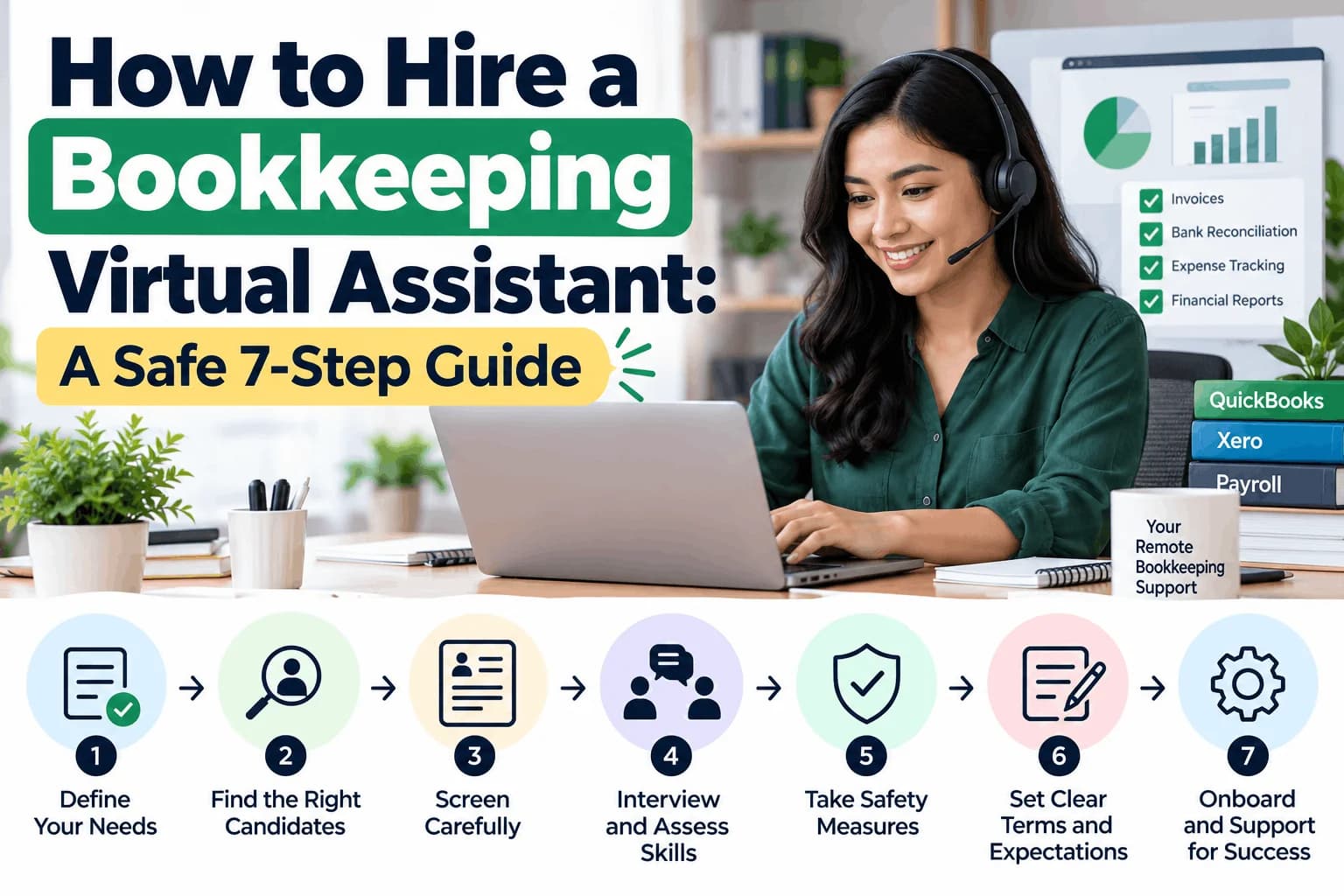
- 3.3. How to Hire a Bookkeeping Virtual Assistant in 7 Practical Steps
- 4.4. A 30-Day Bookkeeping VA Setup for a Growing Service Business
- 5.5. Bookkeeping Virtual Assistant Rates and US Hiring Market Data
- 6.The Access-Control Mistake That Puts Small Business Books at Risk
- 7.Frequently Asked Questions
Most owners look for a bookkeeping virtual assistant after the books have already started to drift: receipts are buried in email, invoices are overdue, bank feeds contain uncategorized transactions, and month end feels like a cleanup project. The expensive mistake is hiring someone to enter data without giving them rules. A reliable bookkeeping VA does not just post transactions. They work inside documented controls, flag exceptions, and leave a clear trail for the owner or accountant to review.
A bookkeeping virtual assistant remotely handles repeatable finance administration, including transaction categorization, invoicing, accounts receivable follow-up, expense documentation, and report preparation under an owner or accountant's review. Safe hiring requires a defined scope, controlled software access, a practical skills test, and recurring reconciliation review.
Table of Contents
- 1. What a Bookkeeping Virtual Assistant Can Handle, and What to Keep With Your Accountant
- 2. Benefits of a Bookkeeping Virtual Assistant for US Small Businesses
- 3. How to Hire a Bookkeeping Virtual Assistant in 7 Practical Steps
- 4. A 30-Day Bookkeeping VA Setup for a Growing Service Business
- 5. Bookkeeping Virtual Assistant Rates and US Hiring Market Data
- The Access-Control Mistake That Puts Small Business Books at Risk
1. What a Bookkeeping Virtual Assistant Can Handle, and What to Keep With Your Accountant
The best way to define this role is by separating repeatable production work from professional judgment. A bookkeeping VA can collect and organize receipts, apply established transaction rules, create invoices, track bills, code routine expenses, clean up vendor records, follow up on accounts receivable, and assemble month-end files for review. They can also maintain a list of open questions instead of guessing when a charge does not fit an existing rule.
Keep tax strategy, signing tax returns, final adjusting journal entries, entity structure decisions, and complex compliance advice with a qualified accountant or CPA. This is not a slight on the VA. It is sensible financial operations. The person entering a transaction should not be expected to make every accounting judgment behind it.
Consider a home services company with 120 monthly transactions. The VA uploads receipts, applies the approved category list, creates weekly invoices, and prepares a Friday exceptions report. The owner approves bills above a chosen threshold and reviews uncategorized items. The CPA reviews the completed month-end package and makes any final adjustments. That workflow is simple, fast, and much safer than asking one person to “handle the books.”
A customer support virtual assistant can help chase a missing receipt or send a polite reminder on an unpaid invoice. They should not independently change an accounting classification just because a customer describes a charge differently. Any change needs a documented rule or owner approval. For a fuller hiring process on that adjacent role, see How to Hire a Customer Support Virtual Assistant: A Step-by-Step Guide.
{{IMAGE_1}}2. Benefits of a Bookkeeping Virtual Assistant for US Small Businesses
The practical payoff is operational calm. When routine work happens every week, the owner is interrupted less often, invoices receive more consistent follow-up, and month-end close is less likely to become an all-night scramble. Clean records also give a CPA less detective work to do and give a lender clearer documentation when a business needs financing.
Specialized support remains a meaningful part of the US hiring landscape. Professional and business services employed 22,635 thousand workers in August 2026, up 0.9% year over year, according to the U.S. Bureau of Labor Statistics. That figure does not measure virtual assistants specifically, but it is useful context: businesses continue to invest in support functions that keep operations moving.
A PH virtual assistant can be a strong option for US firms when their QuickBooks or Xero experience, communication habits, schedule overlap, and security practices fit the actual job. Cost savings matter, but low cost without review controls is false economy. A $10 categorization error can become a costly tax, cash flow, or reporting problem if nobody catches it for months.
3. How to Hire a Bookkeeping Virtual Assistant in 7 Practical Steps
- Audit two recent months of work. Pull bank activity, receipts, invoices, bills, and email requests. List what repeats every week or month. You are looking for stable tasks, not a vague wish for “help with finances.”
- Decide what stays with the owner or accountant. Write down who approves payments, resolves unclear coding, changes vendor bank details, and signs off on reconciliations. Most people get this wrong by deciding responsibilities after an error occurs.
- Create a software-specific scorecard. Score candidates on QuickBooks Online or Xero navigation, spreadsheet accuracy, invoice handling, written communication, and their ability to follow a documented categorization policy. Ask for evidence, not broad claims of being “detail-oriented.”
- Search credible sources and inspect relevant work. Virtual assistant sites can make sourcing easier, but profiles alone are not proof of bookkeeping competence. Look for experience with your software, examples of process documentation, and work similar to your transaction volume. A website for virtual assistant recruiting is a sourcing channel, not a credential.
- Run a paid, controlled test. Provide anonymized transactions, a few invoices, receipts, and written rules. Ask the candidate to categorize items, identify exceptions, and explain assumptions. The explanation is often more revealing than the final answer.
- Verify references and written communication. Ask former clients whether the candidate escalated uncertainty, met deadlines, and kept records organized. Then test communication directly with a realistic email scenario, such as a vendor bill that lacks backup documentation.
- Onboard with minimum necessary access. Use a password manager, role-based permissions, approval workflows, and a weekly review meeting. Give more access only after consistent performance. A weekly review of transactions, invoices, and exceptions catches problems while they are still small.
If you are comparing a MyOutDesk virtual assistant with independent candidates or another managed provider, compare supervision, replacement policy, timezone coverage, bookkeeping specialization, and total cost. Do not compare marketing claims or hourly price in isolation. The right option is the one that gives your business a reliable process and clear accountability.
{{IMAGE_2}}4. A 30-Day Bookkeeping VA Setup for a Growing Service Business
Imagine a US marketing agency owner with recurring client retainers, project invoices, contractor costs, and weekly card transactions. They need invoice tracking and transaction cleanup, but their CPA keeps final month-end review. Here is a practical first month.
- Week 1: Access and process mapping. Set up restricted QuickBooks access, shared receipt storage, a password manager, and a task board. Map how money enters, how bills are approved, and which questions go to the owner or CPA.
- Week 2: Supervised transaction rules. The VA processes a small batch using a written chart of accounts and flags unclear items. The owner reviews the batch, updates rules, and records decisions in a living procedure document.
- Week 3: Invoice and receivables workflow. The VA creates approved invoices, logs sent dates, follows up on balances, and escalates sensitive client issues. No discounts, write-offs, or payment-plan changes happen without approval.
- Week 4: Reporting and quality review. The VA produces a concise weekly dashboard and prepares month-end documents. The owner and CPA review errors, stale items, and access permissions before expanding the role.
A useful weekly dashboard includes uncategorized transactions, invoices overdue more than 14 days, missing receipts, bills awaiting approval, and issues escalated to the owner. This is better than a generic “everything is done” update because it focuses attention where a decision is needed.
Do not confuse this work with Amazon's virtual assistant work, which commonly involves marketplace listings, inventory, or customer messages. Bookkeeping requires access discipline and an accounting workflow. One person can support both functions only when workload, competencies, and permissions are deliberately separated. Read How to Effectively Use Amazon's Virtual Assistant in Your Business for a closer look at that distinct role.
5. Bookkeeping Virtual Assistant Rates and US Hiring Market Data
Virtual assistant rates vary with software fluency, transaction complexity, quality-control responsibility, location, schedule overlap, and whether the provider is independent or managed. Compare the hourly quote with the true monthly cost: onboarding, software seats, owner review time, and rework all count. A lower rate is not cheaper if it creates a second job for the owner.
For broader context, US GDP per capita was $90,026.52 in 2025 and the unemployment rate was 4.2% in 2025, according to the World Bank. Neither number establishes a virtual assistant wage. They simply help explain why US businesses frequently compare remote support models alongside local hiring.
For a deeper cost framework, see Understanding Virtual Assistant Rates: A Complete Guide and Virtual Assistant Pricing: How to Compare Total Hiring Costs.
Source: World Bank Open Data
The Access-Control Mistake That Puts Small Business Books at Risk
The biggest bookkeeping VA risk is usually not a wrong category. It is giving one remote worker the ability to create vendors, enter bills, approve payments, change bank details, and reconcile accounts without independent review. That combination creates an opportunity for error or fraud that may be difficult to spot.
Segregation of duties simply means different people control different stages of a financial action. A VA may enter a bill. An owner or manager approves payment. A CPA or owner reviews the bank reconciliation. Use role-based permissions, read-only bank feeds where available, audit-log reviews, separate payment approval, and a documented vendor-change verification process. If a vendor requests new bank details and a new bill arrives shortly after, a second person should verify the change through a known phone number or established contact, not the email included in the request.
Monthly owner or CPA signoff closes the loop. It does not mean checking every line forever. It means reviewing reconciliations, unusual vendor activity, exceptions, and permissions often enough to ensure the system still works.
Frequently Asked Questions
What does a bookkeeping virtual assistant do?
They handle repeatable tasks such as transaction categorization, receipt organization, invoicing, bill tracking, accounts receivable follow-up, and report preparation. Final tax decisions, complex adjustments, and regulated accounting advice should remain with a qualified accountant or CPA.
How do I test a bookkeeping virtual assistant before hiring?
Use a short paid test with anonymized transactions, invoices, and receipts. Evaluate accuracy, software navigation, documented assumptions, escalation judgment, and written communication. Never provide full bank access or live payment authority during a test.
How much should I budget for a bookkeeping virtual assistant?
Budget depends on software experience, book complexity, location, schedule overlap, and whether the provider is independent or managed. Calculate total cost, including onboarding, software access, owner review time, and likely rework, rather than comparing hourly rates alone.
Can a bookkeeping virtual assistant reconcile bank accounts?
Yes, they can prepare reconciliations using documented procedures. An owner, manager, or CPA should independently review the reconciliation before it is final, and payment approval and bank-detail changes should remain separate from reconciliation duties.
Recommended for you
You might also like
More guides on Bookkeeping Virtual Assistant.
How to Hire a Customer Support Virtual Assistant: A Step-by-Step Guide
Discover the essential steps to hiring a customer support virtual assistant effectively, enhancing your business's efficiency.
How to Effectively Use Amazon's Virtual Assistant in Your Business
Discover how to leverage Amazon's virtual assistant for efficient business operations. Step-by-step guide for maximum productivity.
Step-by-Step Guide to Hiring a Social Media Virtual Assistant
Discover how to effectively hire a social media virtual assistant with this detailed guide. Enhance your business's online presence efficiently.
How to Hire a Cheap Virtual Assistant: A Step-by-Step Guide
Discover how to hire a cheap virtual assistant, including pricing insights and practical steps for finding the right fit for your business.
Latest Virtual Assistant Jobs
Fresh remote VA roles — apply directly